


 https://orcid.org/0000-0003-2230-4884

We thank McCreesh and colleagues for their interest in our review and contribution showing a linear trend in specificity across prevalence in prevalence surveys and community-wide screening studies. This supports the improved specificity found in community settings compared to clinics and confirms that the so-called “spectrum-bias” identified for other diseases [1] also applies to tuberculosis.
One challenge in examining trends across prevalence comes from the various options of numerators and denominators in prevalence surveys. To our understanding, McCreesh et al defined prevalence as bacteriologically confirmed tuberculosis in the general population and in individuals with at least 1 available sputum specimen. We provide an alternative approach focusing on culture-positive prevalence in screen-positive individuals (with symptoms and/or chest radiographic abnormalities) to standardize metrics across all surveys and align prevalence estimates with the population in which specificity is assessed, as previously shown in the Supplementary Methods and Supplementary table 6 [2].
In line with results from McCreesh et al, this approach shows the strong negative association between GeneXpert specificity and tuberculosis prevalence. Our figure highlights decreasing specificity as culture-positive tuberculosis prevalence increases from unenriched populations in community-wide screening studies (prevalence 324 to 394 per 100 000) to enriched screened-positive individuals in prevalence surveys (prevalence 748 to 4481 per 100 000).
Using fitted linear regression equations (Figure 1), we estimate specificity for culture-positive tuberculosis prevalence of 500, 250, 100, and 50 per 100 000 as 0.996, 0.997, 0.998, and 0.998 for Algorithm 1 (Xpert MTB/RIF or Xpert Ultra with trace as negative) and 0.995, 0.997, 0.999, and 0.999 for Algorithm 2 (Xpert Ultra with trace as positive).
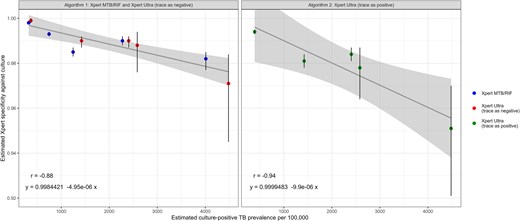
Estimated Xpert specificity by culture-positive tuberculosis prevalence. Linear fits using ordinary least squares method, shown separately for each algorithm. The linear regression equations of the plotted lines and Pearson's correlation coefficients (r) are displayed to quantify the linear relationship between prevalence and specificity found among unenriched community-wide screening populations and screen-positive prevalence survey adult populations (data available in Supplementary Table 4–6 of Veeken et al [2]. and at https://github.com/ldveeken/ClinicCommunityGap).
While these estimates may be more accurate than assumed constant test performance across prevalence, we should be cautious. While all studies identify eligible individuals using active case finding, differences in Xpert eligibility algorithms mean that prevalence may reflect more than just the spectrum of disease severity. Moreover, this analysis assumes a linear association, which may hold within the observed prevalence range but may not apply beyond recorded prevalence, especially on the lower end [1]. Crucially, only 2 community studies were included, across a narrow prevalence range. Therefore, additional empirical data on specificity across prevalence in unenriched community populations is valuable to confirm the accuracy of the curve.
As we move to expand community-wide screening, obtaining accurate estimates of test performance in terms of both sensitivity and specificity, and how these might change with decreasing burden is critical to enable appropriate balancing of the potential benefits and harms of such endeavors. We thank McCreesh and colleagues for stimulating continued discussion and exploration of the available data.
Notes
Data sharing. Data and analysis code is available at GitHub (https://github.com/ldveeken/ClinicCommunityGap).
Financial support. This work was supported by the European Research Council [grant number 757699 to K. C. H. and R. M. G. J. H.]. R. M. G. J. H. is also supported by the National Institutes of Health (NIH-202309-71190). K. C. H. is also supported by the Foreign, Commonwealth and Development Office UK (Leaving no-one behind: transforming gendered pathways to health for TB). This research has been partially funded by UK Aid from the UK government (to K. C. H.); however, the views expressed do not necessarily reflect the UK government's official policies.
Potential conflicts of interest. The authors have declared to no competing interests exist.


