


 https://orcid.org/0000-0002-3782-9045

This scientific commentary refers to ‘Tyrosyl-tRNA sequestration triggers tyrosyl-tRNA synthetase-associated peripheral neuropathy’, by Mallik et al. (https://doi.org/10.1093/brain/awag204).
More subtypes of Charcot-Marie-Tooth disease (CMT) are caused by mutations in aminoacyl-tRNA synthetase (aaRS) genes than any other gene family.1,2 These evolutionarily ancient enzymes covalently link amino acids to their cognate transfer RNAs (tRNAs) for protein synthesis (Fig. 1, top). By selectively ‘charging’ tRNAs with specific amino acids, this process of aminoacylation preserves the genetic code. Accordingly, aaRS loss-of-function causes an array of multisystem disorders. However, it is dominantly inherited missense mutations in aaRS genes that cause the peripheral nerve degeneration characteristic of CMT.1 Indeed, while compromised aminoacylation may contribute to neuropathy, it is not essential for pathogenesis, as several CMT aaRS mutations have no impact on this housekeeping function (e.g. YARS1/TyrRSE196K).1 Instead, a toxic gain-of-function mediated by structural relaxation and exposure of new protein surfaces has emerged as a key component of aaRS-linked neuropathy.3 Several aberrant interactions have been identified, including some shared across different mutant aaRS proteins (e.g. neuropilin 1).2 However, their contribution to disease pathogenesis has remained unclear. In this issue of Brain, Mallik and colleagues4 provide strong evidence that altered interactions between mutant aaRS proteins and their cognate tRNAs offer a unifying explanation for aaRS-linked neuropathy, and one that is highly amenable to therapeutic intervention.
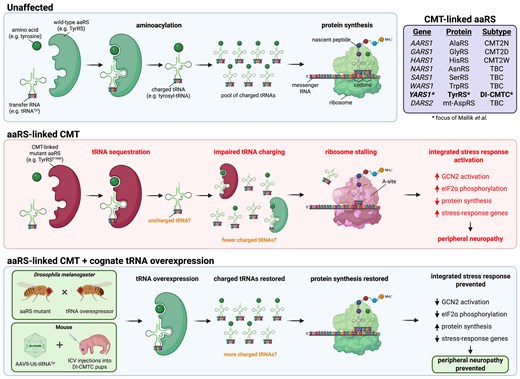
Charcot-Marie-Tooth disease-linked aminoacyl-tRNA synthetase mutants fail to let go of cognate transfer RNAs. Top right: Dominant missense mutations in eight aminoacyl-tRNA synthetase (aaRS) genes cause Charcot-Marie-Tooth disease (CMT). Asterisks highlight the focus of Malik et al.4 Top left: To ensure fidelity of the genetic code, aaRS proteins charge amino acids with cognate transfer RNAs (tRNAs) for protein synthesis. Middle: Mutant aaRS proteins sequester cognate tRNAs, causing ribosome stalling, likely through reduced availability of charged tRNAs (although this has not been directly shown). The integrated stress response (ISR) is then activated via general control nonderepressible 2 (GCN2), which phosphorylates eukaryotic initiation factor 2α (eIF2α). This restricts protein synthesis and initiates stress-response gene expression, together causing peripheral neuropathy. Bottom: Overexpression of cognate tRNA in aaRS CMT models, which presumably increases charged tRNA availability, restores protein synthesis, prevents ISR activation and averts peripheral nerve dysfunction. DI-CMTC = dominant-intermediate CMT subtype C; ICV = intracerebroventricular; mt-AspRS = mitochondrial aspartyl-tRNA synthetase; TBC = to be confirmed. Created in BioRender. Sleigh, J. (2026) https://BioRender.com/4cedhqn.
More than a decade ago, the Storkebaum laboratory published a study in which they modelled GARS1-linked CMT subtype 2D (CMT2D) and YARS1-linked dominant-intermediate CMT subtype C (DI-CMTC) in Drosophila.5 Providing the first evidence for a common pathomechanism, they showed that expression of mutant human GARS1 or YARS1 disrupts protein synthesis in peripheral nerves. In mutant GARS1 flies, this was linked to reduced lifespan, impaired motor function and decreased neuromuscular junction (NMJ) innervation. Consistent with findings in mice,6 wild-type GARS1 overexpression had no rescue effect, supporting a toxic gain-of-function mechanism.5
Seminal follow-up work later provided a molecular explanation for how GARS1 mutations restrict translation (Fig. 1, middle).7,8 Mutant GlyRS interacts with glycine tRNA (tRNAGly) with roughly 10%–50% of the affinity of wild-type GlyRS, but fails to let go of the tRNA or does so only slowly. Consequently, ribosomes stall more frequently at glycine codons in the spinal cords of CMT2D mice.7 This initiates the integrated stress response (ISR) through activation of general control nonderepressible 2 (GCN2),8 which phosphorylates eukaryotic initiation factor 2α (eIF2α), ultimately driving stress-response gene expression and reducing translation in motor neurons.7,8 In the short-term, the ISR protects against diverse stressors, but long-term activation is detrimental and linked to numerous neurodegenerative diseases. Accordingly, transgenic overexpression of tRNAGly in both fly and mouse models of CMT2D reduced eIF2α phosphorylation, restored protein synthesis, and produced unprecedented rescue of neuropathy.7 Conversely, global genetic deletion of GTP binding protein 2 (Gtpbp2), which helps resolve ribosome stalling, exacerbated the CMT2D mouse phenotype.7 Further supporting a key role for the ISR in GARS1 CMT, global genetic deletion or pharmacological inhibition of Gcn2 caused strong, albeit incomplete, phenotypic rescue of CMT2D mice.8 ISR activation also occurs in motor neurons of DI-CMTC mice8; nonetheless, it remained unclear whether sequestration of tRNATyR by mutant TyrRS drives neuropathy through the same mechanism.
To tackle this important question, Mallik et al.4 returned to the three DI-CMTC mutant Drosophila strains originally shown to display defective protein synthesis.4,5 Using the GAL4-UAS system, they expressed TyrRS variants G41R, 153-156delVKQV and E196K in sensory neurons, motor neurons, pan-neuronally or ubiquitously. All three mutations cell-autonomously impaired sensory nerve morphology to a similar extent and reduced protein synthesis within motor neurons (153-156delVKQV ≈ E196K>G41R). However, only E196K reduced larval NMJ size and impaired adult motor performance when expressed in motor neurons and pan-neuronally, respectively. Furthermore, only 153-156delVKQV and E196K induced developmental lethality when ubiquitously expressed, with the latter producing the more severe phenotype.
The authors then crossed these DI-CMTC models with flies overexpressing tRNATyr (∼1.7-fold). Boosting tRNATyr availability resulted in essentially complete rescue of all identified deficits, consistent with tRNATyr sequestration by mutant TyrRS causing impaired translation and the other neuropathy phenotypes. The excess tRNATyr presumably provides more substrate for wild-type TyrRS. Consistent with cognate tRNA being required for amelioration, the authors had previously shown that tRNAGly overexpression rescues Drosophila models of GARS1 neuropathy, but not YARS1.7 Here, tRNATyr likewise failed to improve phenotypes in two different CMT2D strains, confirming that rescue requires the cognate tRNA.
Immunoprecipitation experiments in fly larvae showed increased binding between tRNATyr and all three DI-CMTC mutants, albeit without statistical testing. Ribosome profiling then revealed that the two tyrosine codons (UAC and UAU) were more frequently vacant at the ribosome aminoacyl site (A-site) in the 153-156delVKQV and E196K mutants than in controls. The A-site accepts incoming charged tRNAs, thus these data are consistent with ribosome stalling occurring specifically at tyrosine codons, likely due to a shortage of tRNATyr primed for protein synthesis.
Moving to DI-CMTC mice, the authors designed a preclinical gene therapy in which a construct expressing tRNATyr under the highly active RNA polymerase III promoter U6 was packaged into adeno-associated virus serotype 9 (AAV9) (Fig. 1, bottom). This treatment and two controls—AAV9 vectors expressing either tRNAGly or wild-type TyrRS—were then delivered to the brains of newborn mice via intracerebroventricular injection. Six months post-administration, AAV9-U6-tRNATyr fully restored motor performance on the wire hang test, sciatic nerve conduction velocities and motor axon size, without affecting wild-type mice. In contrast, neither AAV9-U6-tRNAGly nor AAV9-CMV-YARS1 improved the DI-CMTC phenotype, confirming both the specificity of the rescue and that loss of TyrRS function does not contribute to neuropathy. Importantly, AAV9-U6-tRNATyr increased tRNATyr availability in the spinal cord (∼1.7-fold), fully suppressed stress-response gene expression and prevented ISR activation.
Together, these findings provide compelling evidence that, much like mutant GlyRS, CMT-causing mutations in YARS1 prevent efficient release of tRNATyr by mutant TyrRS. This most likely reduces delivery of tyrosyl-tRNAs to the ribosome, causing stalling at tyrosine codons. The resulting ribosome stalling is associated with ISR activation, almost certainly via GCN2, leading to increased eIF2α phosphorylation, reduced protein synthesis and expression of stress-response genes. The striking consistency across CMT2D and DI-CMTC models strongly suggests that tRNA sequestration may represent a common mechanism across aaRS-linked neuropathies, although this remains to be confirmed in additional subtypes. Crucially, work from the Storkebaum and Burgess groups has now shown that targeting this pathomechanism is highly feasible and results in impressive rescue in both Drosophila and mouse models of two different aaRS-linked CMTs.4,7,8 Provision of excess cognate tRNAs, which is aaRS-specific, or dampening the ISR through GCN2 inhibition, which could potentially be applied across aaRS-linked CMTs, are exciting therapeutic approaches that may one day be translated to the clinic. Key questions remain, however, including whether AAV-mediated tRNA delivery will also rescue CMT2D mice, whether drugging the ISR pathway will benefit DI-CMTC, and whether treatment is also effective post-symptom onset. This last point is particularly important because presymptomatic treatment is likely to be feasible only for individuals with a known family history.
Despite the comprehensive and consistent nature of these results, several specific and broader questions are still to be answered. For example, how is GCN2 activated? Ribosome stalling and associated collisions can activate GCN2, but so can GCN2 binding to uncharged tRNAs. It is therefore unclear whether uncharged tRNAs accumulate and/or charged tRNAs become less abundant in neurons expressing mutant aaRS proteins. The ratio of charged to non-aminoacylated tRNAGly has been measured in fly larvae5 and HEK293T cells,9 but was unaffected by mutant GlyRS. Direct evidence that charged tRNAs are less abundant in aaRS disease models is therefore lacking and is inferred mainly from ribosome profiling. It also remains unknown whether blocking GCN2 restores protein synthesis in these models. Resolving this issue may reveal whether it is stress-response gene activation or reduced protein production that is the primary driver of neuropathy.
The part of the study that would benefit most from further investigation is the in vitro immunoprecipitation experiments between TyrRS variants and tRNATyr. Without statistical analysis, the data hint that mutations increase interaction, but it remains to be determined whether it is association, dissociation or a combination of the two that is altered. Moreover, the pathological congruence between different TyrRS variants is limited. For instance, it is unclear why the 153-156delVKQV and E196K mutants similarly perturb protein synthesis in motor neurons, yet have different effects on larval NMJ size, adult motor function and survival. This mirrors a broader discrepancy in CMT2D mice, whereby protein synthesis impairment occurs to a similar extent across the spinal column,8 yet lumbar motor neurons are more severely affected than those in thoracic regions.10
These findings also raise two longstanding questions in CMT: Why are peripheral nerves selectively affected when aaRS proteins are found in all cells? Why is neuropathy selective even within peripheral nerve subpopulations? Protein synthesis is unaffected in the liver and heart of CMT2D mice,8 but mutant GARS1 overexpression in HEK293T cells causes ribosome stalling, ISR activation and impaired translation.9 Further work is therefore required to fully understand peripheral nerve selectivity. Indeed, YARS1 mutations cause a lower-limb predominant intermediate CMT that affects both axons and Schwann cells, whereas GARS1 variants cause a purely axonal neuropathy, with variable sensory involvement and frequent upper limb-onset. Is this due to differential availability and/or spatial distribution of aaRS proteins, tRNAs and/or amino acids, or is there another cause, for example, neuron-specific tRNA modifications or additional aberrant interactions?1,2
These questions notwithstanding, Mallik et al.4 provide critical insight into a unifying pathomechanism driving neuropathy in aaRS-linked CMTs. The study confirms that by not letting go of tRNAs, mutant aaRS proteins cause ribosome stalling that activates the ISR and restricts protein synthesis. Vitally, a gene therapy targeting this pathway through cognate tRNA augmentation resulted in full rescue of DI-CMTC mice, suggesting that clinical translation may now be within reach.
Funding
J.S. is funded by the Medical Research Council (MR/Y010949/1).
Competing interests
The author reports no competing interests.


