


Abstract
100 years ago, the main treatments for asthma were the sympathomimetic ephedrine, theophylline tablets, inhaled anticholinergics in the form of “asthma cigarettes”. Together with adrenaline injections for acute exacerbations, these treatments were all bronchodilators derived from natural products. Adrenaline injections evolved into inhaled β2-agonists as the most effective bronchodilators in asthma, whereas theophylline and inhaled anticholinergics are less useful treatments. The efficacy of desiccated adrenal glands extract, used since 1900, is likely due to steroids derived from the adrenal cortex. Corticosteroids are the most effective treatment for asthma and target the underlying eosinophilic airway inflammation. Combination inhalers of corticosteroid and long-acting β2-agonist are now the mainstay of asthma therapy. Recently, short-acting β2-agonists as relievers have been replaced by relievers containing an inhaled corticosteroid, together with a rapid onset long-acting β2-agonist formoterol (anti-inflammatory reliever). This addresses the major issue of poor adherence with inhaled corticosteroids. Poor inhaler technique is being addressed with the development of smart inhalers. In patients with severe asthma not controlled by inhaled therapy, antibodies that block cytokines involved in eosinophilic inflammation have been very effective. In the future, longer acting antibodies will simplify the treatment of these patients. New drugs are also in development for severe non-eosinophilic asthma. There have been remarkable advances in asthma therapy over the last century, although our current treatments have their origins in the therapies used in 1925.
This article is based on a talk given at the Centenary Conference of the Postgraduate Medical Journal, held at the Royal Society of Medicine in London on December 2nd 2025. The talk may be accessed on the Fellowship of Postgraduate Medicine website: https://thefpm.org.uk.
There have been remarkable changes in our understanding and treatment of asthma over the 100 years since the Postgraduate Medical Journal was first published in 1925. Sir William Osler, Regius Professor of Medicine in Oxford and founding member of the Federation of Postgraduate Medicine, wrote the definitive textbook of medicine “Principles and Practice of Medicine” used at the time. He viewed asthma as a neural reflex with triggers, such as emotional stress, allergens and colds. He also stated that asthmatics “pant into old age” and did not believe it to be a fatal disease [1]. Both of these assertions are incorrect, but because of his fame and influence, for many years asthma was considered to be a mild psychosomatic disease. However, Osler did recognize mucosal oedema as a component of asthma, in addition to bronchospasm, although this had been established in the 19th Century by Dr Hyde Salter FRS of Charing Cross Hospital in London [2].
Asthma treatment in 1925
In 1925 the sympathomimetic ephedrine from the traditional Chinese herbal medicine ma huang, derived from the plant Ephedra sinica, was widely used as a bronchodilator for symptomatic relief (Fig. 1) [3]. Theophylline, extracted from tea leaves and cocoa beans, was also used as an oral bronchodilator. Anticholinergics, such as atropine obtained from Atropa belladonna (deadly nightshade) and stramonium (from Datura or thornapple) had been used in Ayurvedic medicine in India since the 17th century and inhaled from burning leaves of these plants. These bronchodilators were widely available in several brands of “asthma cigarette.” Adrenaline, derived from dried extract of adrenal glands, was used by injections to treat acute exacerbations of asthma. Thus, all of the treatments used for asthma 100 years ago were derived from natural products and have evolved into our currently used bronchodilator therapies.
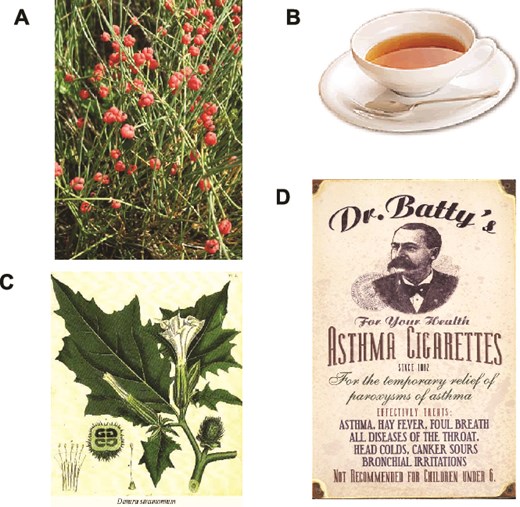
Asthma treatments 100 years ago were bronchodilators derived from natural products. Panel A: Ephedra sinica Which gives the sympathomimetic ephedrine. Panel B: Theophylline is derived from tea leaves and cocoa beans. Panel C: Datura stramonium (thornapple) leaves contain the anticholinergic stramonium. Panel D: Asthma cigarettes contained stramonium or atropine with tobacco.
Adrenergic bronchodilators
Inhaled β2-agonists are the most effective bronchodilators for asthma today. At the beginning of the 20th century dried extract of adrenal gland was shown to be beneficial for asthma and adrenaline was isolated from this extract by Takamine in 1901 [4]. Adrenaline (epinephrine) was usually given by subcutaneous injection but later found to be effective when delivered by nebulizer directly to the lungs. The first β-agonist, isoprenaline, was synthesized by German chemists in the 1940 and by the mid-1950s both isoprenaline and adrenaline were given by pressurized metered dose inhalers (pMDI) for rapid symptomatic relief. But these adrenergic agonists caused tachycardia and palpitations due to cardiac stimulation (Fig. 2). In 1967 Lands used a series of antagonists to differentiate β1-receptors that mediate cardiac stimulation and β2-receptors responsible for bronchodilatation. This led to the development in the early 1970s of the β2-selective agonists salbutamol and terbutaline, which have become the most widely used anti-asthma drugs today and are used mainly as a reliever inhalers to rapidly reduce symptoms. Salbutamol and terbutaline, which induce bronchodilatation for 3–4 hours, are called short-acting β2-agonists (SABA). By 1990 Sir David Jack FRS, a pharmacologist working for Allen and Hanbury’s, who had discovered salbutamol, identified the first long-acting β2-agonist (LABA) salmeterol, which lasted for ~12 hours [5]. Formoterol., another LABA of similar duration was also discovered shortly afterwards, and had a rapid onset of action (so could also be used as a reliever), whereas salmeterol had a slower onset reaching a peak at ~1 hour after inhalation. In the early 2000s the ultra-LABA indacaterol was discovered, followed by vilanterol, olodaterol, and abediterol, all of which have a bronchodilator action of over 24 hours and are therefore suitable for once daily inhalation [6].
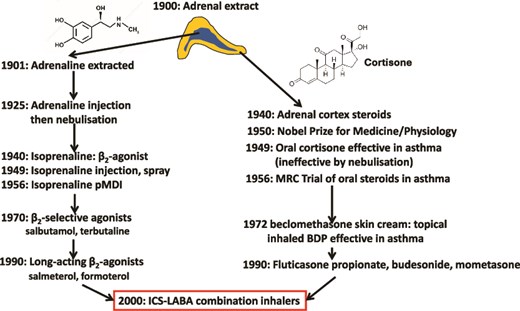
The evolution of ICS-LABA combination inhalers from desiccated adrenal glands.
In the 1960s isoprenaline inhalers were widely used and overuse was linked to a rise in asthma deaths that were thought to be linked to its cardiovascular effects. This led to the development of β2-selective agonists that have less cardiovascular effects. Another peak in asthma deaths occurred in the 1970s, particularly in New Zealand, where this was linked to overuse of fenoterol, which was less selective for β2-receptors than salbutamol and therefore had greater cardiac stimulatory effects. However, subsequent pharmacoepidemiology studies demonstrated that overuse of all β2-agonists is linked to worsening asthma and increased mortality. It is now thought that the most plausible link between β2-agonist overuse and mortality is the overreliance on bronchodilators, rather than treating the underlying asthmatic inflammation. Because of this may be a particular problem with LABAs, they are now only prescribed for asthma in combination with a corticosteroid. Overuse of SABAs is a still a global problem and patients using ≥3 canisters/year are at risk of increased exacerbations and death [7]. Furthermore, overuse of β2-agonists has been linked to increased asthmatic inflammation, so the most used reliever paradoxically worsens asthma. This problem has now been overcome by adding an inhaled corticosteroid (ICS) to the SABA or formoterol reliever, and this has become the preferred therapy for all asthmatic patients [8].
Anticholinergics
The smoke of dried Datura leaves, which contain the muscarinic receptor antagonist stramonium, have been used since the 17th century in India as part of Ayurvedic medicine, so inhaled anticholinergics have a long history. In 1925 “asthma cigarettes” containing atropine or stramonium combined with tobacco were widely used by asthmatic patients—and recommended by Osler! However, side effects from these anticholinergics were a major problem. In addition to dry mouth and urinary retention, these anticholinergics had central nervous system side effects, such as hallucination. Ipratropium bromide, a quaternary ammonium derivative of atropine, did not cross the blood–brain barrier and so avoided these CNS side effects. Ipratropium bromide was developed as an inhaled bronchodilator with a duration of action of 3–4 hours. Short-acting muscarinic antagonists (SAMA) were less effective as relievers than SABA in asthmatic patients but had additive bronchodilator effects, so combinations of SABA and SAMA became popular. Tiotropium bromide was the first long-acting muscarinic antagonist (LAMA), which had a duration of over 24 hours, and so suitable for once-daily dosing [9]. LAMA are less effective than LABA as bronchodilators asthma as they block only the cholinergic reflex component of bronchoconstriction, whereas they are more effective than LABA in COPD patients, in whom this mechanism predominates. Subsequently, several other LAMAs were developed, including glycopyrrolate, umeclidinium, aclidinium and revefenacin, but are used mainly is the treatment of COPD.
Theophylline
Coffee drinking had long been recognized as beneficial in asthmatic patients, as caffeine has weak bronchodilator effects [2]. However, theophylline, a methyl xanthine derived from tea leaves and cocoa, was a more effective bronchodilator and in 1925 was used in tablet form by asthmatic patients [1]. The bronchodilator effect of theophylline is due to inhibition of phosphodiesterase-3, resulting in airway smooth muscle relaxation due to an increase in cyclic AMP [10]. Aminophylline is a more soluble form of theophylline and suitable for injection and recommended as an intravenous therapy for exacerbations of asthma in the 1940s. A major problem of methyl xanthines is side effects from the high doses needed to produce effective bronchodilatation. These side effects included nausea and vomiting due to inhibition of phosphodiesterase-4, and more severe side effects, such as cardiac arrhythmias and seizures, due to antagonism of adenosine A1-receptors. Measurement of plasma theophylline concentrations was used to determine the optimal dose for individual patients, but theophylline metabolism was affected by many factors, making it difficult to use in clinical practice. In the 1990s several studies showed that at lower doses of theophylline has anti-inflammatory and immunomodulatory effects, so slow-release theophylline tablets were commonly used in lower doses as a maintenance treatment for asthma.
Corticosteroids
Desiccated adrenal glands were found to be beneficial for asthma symptoms at the beginning of the 20th century and this was ascribed to the bronchodilator effect of adrenaline, derived from the adrenal medulla. However, adrenaline is poorly absorbed after oral ingestion, so it is more likely that the benefit of adrenal extract was due to glucocorticosteroids derived from in the adrenal cortex. In 1940 adrenal cortex steroids were isolated and in 1950 the Nobel Prize in Medicine and Physiology was given to the chemist Edward Kendal and the rheumatologist Philp Hench at Mayo Clinic for the isolation and clinical effects of adrenal steroids (Fig. 2). Oral cortisone was found to be highly effective in the treatment of rheumatoid arthritis, but also dramatically effective when given to asthma patients. McCombs reported the remarkable improvement of five asthmatic patients treated with oral cortisone [11]. However, side effects, such as fractures and metabolic disturbance, proved to be a major problem. In an attempt to avoid these systemic effects hydrocortisone was given by nebulization, but this proved to be ineffective. The first controlled trial of oral corticosteroids in asthma was surprisingly negative, but this was because most of the patients included in the study were patients with COPD, a steroid-resistant disease [12]. Dr. Harry Morrow-Brown, an allergist from Derby, reported that the only patients to show a good response to corticosteroids were those with increased eosinophils in the sputum [13]. This was the first indication that corticosteroids worked by suppression of eosinophilic inflammation in asthma. Because of adverse effects, oral corticosteroids are mainly given as short courses for exacerbations of asthma, although a few patients with very severe asthma may require low doses for maintenance therapy.
A key breakthrough was the development of ICS. Topical corticosteroids were effective on inflammatory skin diseases and one such steroid, beclomethasone dipropionate (BDP), was found by Sir David Jack’s group to be effective in controlling asthma symptoms without significant systemic side effects. In 1972 Morrow Brown reported that patients dependent on oral corticosteroids could be switched to BDP [14]. A large trial coordinated by the British Thoracic Society showed that BDP was highly effective in controlling asthma in patients with moderate-to-severe asthma [15]. BDP was followed by fluticasone propionate, budesonide, mometasone and ciclesonide, which has fewer systemic side effects. ICS have revolutionized the management of asthma [16]. ICS remain the most effective way to control asthma symptoms, prevent exacerbations and to reduce mortality. They are largely free of adverse effects and are effective in patients of all severities of asthma, including children. However, in contrast to β2-agonists, they only slowly resolve asthmatic inflammation in the airways, so patients are poorly compliant as they do not perceive any symptom relief.
ICS-LABA combination therapy
A critical study undertaken in general practice in the UK showed that in asthmatic patients treated with low doses of BDP who still had symptoms, adding the salmeterol was more effective in controlling asthma than more than doubling the dose of ICS [17]. This was confirmed with addition of formoterol to a low dose of budesonide, which was more effective in preventing exacerbations than a 4-fold increase in budesonide dose [18]. Many subsequent studies confirmed that combining an ICS and LABA given twice a day as maintenance treatment was more effective than increasing the dose of ICS and this became routine practice, together with a SABA used as a reliever for breakthrough symptoms. Indeed, a molecular interaction between β2-agonists and corticosteroids provided additional benefit as steroids increase β2-receptor numbers and function and prevent their downregulation. Furthermore, β2-agonists increase the nuclear localisation of glucocorticoid receptors and thus enhance the anti-inflammatory effects of corticosteroids [19]. A further advance in therapy was the discovery that using the budesonide-formoterol combination inhaler as a reliever, as well as twice-daily maintenance therapy, was more effective than using a SABA reliever [20]. This single maintenance and reliever therapy approach was more effective in preventing exacerbations and controlling asthma than conventional approaches using ICS-LABA and SAMA and is now recommended for all patients with moderate to severe disease. Patients with mild asthma were treated either with SABA reliever if symptoms were infrequent or with the addition of low dose of ICS, but using budesonide-formoterol instead of SABA as a reliever (anti-inflammatory reliver) was more effective in preventing exacerbations [8, 21] and this has now become the preferred treatment approach for most patients with asthma.
Current therapy for asthma
Asthma is usually well managed in general practice in the UK, greatly helped by specialist asthma nurses in many practices. The mainstay of treatment is ICS combined with LABA and the dose of ICS is escalated until asthma symptoms come under control [22]. As discussed above, the preferred treatment for patients with mild asthma (around 70% of all patients) is an ICS-formoterol or ICS-SABA reliever, rather than a SABA alone, which may paradoxically worsen asthma control. For patients with moderate-to-severe asthma maintenance treatment with an ICS-LABA combination inhaler (usually twice daily) is indicated. The preferred approach is to use an ICS-formoterol inhaler twice daily and as a reliever, so that a single inhaler can be used to control asthma. Poor adherence with maintenance treatment is a major barrier to effective control of asthma, although this is counteracted by using an anti-inflammatory reliever.
Oral theophylline is now rarely used, although it low doses be added to maximum doses of ICS-LABA in severe asthma [23]. Inhaled LAMAs may provide additional bronchodilatation in severe asthma but have little effect on symptoms and exacerbations [24]. The patients that benefit most from LAMA are those with concomitant COPD and have an element of fixed airway obstruction; in these patients a triple inhaler (ICS = LABA-LAMA) may be convenient. Although in the past inhaled sodium cromoglycate was used as a prophylactic therapy, especially in children, long-term studies found that it is ineffective in long-term control of asthma, probably due to its short duration of action [25]. Multiple inflammatory mediators are released in asthma, particularly from activated mast cells in the airway mucosa. A prominent bronchoconstrictor mediator is histamine, but antihistamines are ineffective as bronchodilators in asthma as many other bronchoconstriction mediators are also release [26]. Cysteinyl -leukotrienes are potent bronchoconstrictors and anti-leukotrienes (Cys-LT receptor-1 antagonists) are weak bronchodilators and have been used in the treatment of mild asthma but are far less effective than ICS and so are now little used in the UK. Oral corticosteroids (usually prednisone or prednisolone) are used in short courses for treating acute exacerbations and in a small percentage of very severe asthma patients as a maintenance treatment.
Severe asthma
Although we now have effective inhaled therapies for asthma, many patients remain poorly controlled in the real world. Much of this poor control is due to low adherence with ICS therapy; only ~20% of patients prescribed ICS (usually ICS-LABA) inhalers take them regularly as prescribed. Furthermore, many patients do not use inhaler devices correctly, so do not receive adequate treatment of the lungs. However, around 5% of patients with asthma have severe disease, which is defined as poor control despite using maximal doses of inhaled drugs correctly. Asthma is usually not progressive, so severe asthma may be found at the onset of disease, indicating that it may be a different type of airway disease. Although severe asthma is seen in only 5% of asthmatic patients in the community, it accounts for >50% of healthcare spending on asthma, due to the cost of medication and exacerbations (especially those involving hospitalisation), and absence from work or school. Different inflammatory phenotypes of severe asthma have been described, depending on the prominence of inflammatory cells in induced sputum.
Around 60% of severe asthma patients have a predominance of eosinophils, despite high doses of ICS and oral corticosteroids The development of biological therapies directed against the cytokines involved in eosinophilic inflammation has been a major advance in the management of these patients, by reducing exacerbations and the need for oral steroids [27]. The first biologic, omalizumab, was introduced over 25 years ago and blocks circulating IgE, which is the major trigger of mast cell activation in asthma. Omalizumab is very effective in some patients with allergic asthma, but it has proved difficult to identify which patients will benefit. The first antibody against a T2 cytokine, was mepolizumab, which blocks IL-5 and dramatically reduces blood and airway eosinophils [28]. Mepolizumab blocks circulating IL-5, whereas benralizumab blocks the IL-5 receptor (IL-5Rα). Both treatments reduce exacerbations in severe eosinophilic asthma by ~50% and reduce the need for oral steroids, yet have little effect on lung function, symptoms or asthma control. By contrast, dupilumab, which targets IL-4Rα, the common receptor for the T2 cytokines IL-4 and IL-13, reduces exacerbations by around 70% and improves lung function and symptoms. Dupilumab is also effective against chronic rhinosinusitis with or without polyps and in atopic dermatitis, which are common allergic comorbidities in severe asthma [29]. An “upstream” cytokine thymic stromal lymphopoietin (TSLP) is highly expressed in airway epithelium of patients with severe asthma and orchestrates T2 inflammation in asthma. Blocking TSLP with tezepelumab is effective in reducing exacerbations and improving asthma control [30]. Tezepelumab is given as a monthly subcutaneous injection, whereas dupilumab needs to be injected twice weekly. These T2 biologics have been dramatically effective in some patients with eosinophilic severe asthma, who are selected based on the T2 biomarkers blood eosinophils and fractional exhaled nitric oxide (FeNO). Using these biomarkers allows a more precision approach to treatment; those patients with high blood eosinophils respond best to anti-IL-5, those with increased FeNO to dupilumab and those with both increased to tezepelumab.
Some patients with severe asthma have a neutrophilic pattern of sputum inflammation, but there are currently no treatments that effectively target this pattern of inflammation in asthma. Anti-neutrophil treatments, such as CXCR2 antagonists, have been ineffective. Tezepelumab has some efficacy in non-T2 asthma, as it may target T2 and T3 immunity associated with neutrophilic inflammation. Finally, some patients with severe asthma do not have increased inflammatory cells in the sputum (paucigranulocytic). These patents may be improved by mechanical procedures, such as bronchial thermoplasty, and selective airway denervation.
Future therapies
Poor adherence and inhaler technique are the main reasons for poor control of asthma in the real world. Over 50% of asthmatic patients do not use inhalers correctly, but the development of smart inhalers that monitor inhaler digitally use may improve compliance [31]. It is likely that use of artificial intelligence will improve the diagnosis and management of asthma in the future.
Several novel biological therapies are in development for the treatment of severe asthma. High affinity antibodies have a longer duration of action and may be suitable for six monthly or even annual injection. Depemokimab is a six monthly anti-IL-5 antibody that has recently been approved in the UK [32]. Long-acting antibodies are also in development against IL-4Rα and TSLP. Several studies have investigated antibodies that target IL-33 or its receptor (ST2). Like TSLP, IL-33 is an “upstream” cytokine expressed in airway epithelium in severe asthma, but so far these biologics have not been as effective as tezepelumab in clinical trials. Antibodies are expensive, amounting to £20-30 k/year, but it is expected that generic versions, biosimilars, will reduce costs in the future. At present biologics are restricted to patients with severe asthma, but if they become less expensive may be useful in treatment less severe asthma. An oral drug, dexpramipexole, is a dopamine agonist that unexpectedly reduces blood eosinophils. It has shown some benefit on lung function in asthmatic patients and is currently in larger clinical trials [33].
There are no very effective treatments for severe neutrophilic asthma, although some respond to macrolide antibiotics. Several treatments that target neutrophilic inflammation, including JAK, IRAK4 and NLRP3 inflammasome inhibitors are currently under investigation.
Conclusions
Over the last 100 years there have been remarkable improvements in asthma therapy. In 1925 the only treatments available were derived from natural products and included adrenaline injections, inhaled anticholinergics and theophylline tablets. Inhaled β2-agonists developed from adrenaline as the most effective inhaled bronchodilators of asthma. ICS that target the underlying T2 inflammation in asthma have been the most important advance and in combination with LABA are now the mainstay of treatment. Inhaled anticholinergics, theophylline, sodium cromoglycate and anti-leukotrienes provide relatively little benefit. Recently, targeted therapy against T2 inflammation with antibodies that block T2 cytokines have been highly effective in selected patients with severe eosinophilic asthma. Several other new treatments, particularly longer acting antibodies, are in development as well as drugs that target non-T2 severe asthma. A major ongoing issue is the poor control of asthma in the real world due to low adherence with ICS and poor inhaler technique. This is being addressed using ICS in rescue bronchodilators and the development of smart inhaler devices.
Main messages
Asthma treatment in 1925 included ephedrine and theophylline tables, inhaled anticholinergics (“asthma cigarettes”) and adrenaline injections.
Adrenaline isolated from the adrenal medulla evolved into inhaled isoprenaline, selective β2-agonists, then to long-acting β2-agonists (LABA).
Steroids from the adrenal cortex let to cortisone treatment then to inhaled corticosteroids (ICS), which are now combined with LABA as the mainstay of asthma treatment.
Short-acting β2-agonists, such as salbutamol, are now being replaced by ICS-formoterol relievers (anti-inflammatory relievers).
Patients with severe eosinophilic asthma are now treated with biological therapies (antibodies), which target the cytokines that drive eosinophilic inflammation (IL-4, IL-5. IL-13, TSLP).
Research questions
1) Which are the most effective treatments for non-T2 severe asthma?
2) Will biological therapies be useful in mild–moderate asthma?
3) Is a cure for asthma feasible?
Self-assessment questions
1) Adrenal extract was effective in asthma because of its adrenaline content
2) Anticholinergic inhalers are as effective as β2-agonist inhalers in asthma
3) Inhaled hydrocortisone is effective in asthma
4) Anti-inflammatory relievers are more effective than SABA relievers
5) Anti-IL-5 antibodies improve symptoms in severe asthma
Answers:
1. False
2. False
3. False
4. True
5. False
Authors contributions
I am the sole author of this article.
Conflicts of interest
No conflicts to declare.
Funding
None declared.


