


 https://orcid.org/0000-0003-4974-9058

Abstract
Background
By the end of 2021 in the United States, spike (S) antibody seroprevalence from coronavirus disease 2019 (COVID-19) vaccination, infection, or both (hybrid immunity) reached over 90%. With high seroprevalence, quantitative antibody concentrations are needed to characterize population immunity. We measured quantitative S antibody concentrations in a national blood donor cohort and evaluated their correlation with protection against infection.
Methods
One blood specimen per quarter in 2022 was tested for quantitative S immunoglobulin G (IgG) and infection-induced (nucleocapsid [N]) total Ig antibodies from a national blood donor cohort of 106 969 people. Median S antibody concentrations were calculated by quarter and by history of vaccination and infection. Among vaccinated donors without N antibodies, protection (measured as 1 minus hazard ratios compared with unvaccinated donors) against N antibody seroconversion was estimated by S antibody concentration. Median S antibody levels were compared using the Kruskal-Wallis tests.
Results
Median S antibody concentrations increased from 1380 binding antibody units (BAU)/mL in quarter 1 of 2022 to 1720 BAU/mL in quarter 4 of 2022. In quarter 4, S antibody levels were lowest in the infection-only group (median, 75 BAU/mL) and higher in the vaccine-only group (median, 1950 BAU/mL) and hybrid immunity group (median, 2550 BAU/mL). Protection against first-time infection increased with higher antibody concentrations; 5010 BAU/mL (95% confidence interval, 4120–6550 BAU/mL) was associated with 50% protection.
Discussion
During 2022, this nationwide study showed mildly increased S IgG concentrations over time among blood donors. Vaccination and hybrid immunity resulted in higher antibody concentrations than infection alone. Higher antibody concentrations were associated with increased protection from infection.
Severe acute respiratory syndrome coronavirus 2 (SARS-CoV-2) antibody seroprevalence studies have been used to monitor the cumulative number of people with prior infections, coronavirus disease 2019 (COVID-19) vaccinations, or both (hybrid immunity) since 2020. By the end of 2021 in the United States, over 90% of adults were estimated to have antibodies from prior infection or vaccination [1]. As the proportion of the US population with SARS-CoV-2 antibodies has increased, the national incidence of COVID-19 hospitalizations and deaths has decreased, including during periods of increased SARS-CoV-2 circulation, compared with early years of the pandemic [2]. This is likely because prior infection and vaccination offer long-lasting protection against severe disease while protection against asymptomatic infection and mild disease wanes more quickly [3].
In the setting of high seroprevalence and waning immunity, repeat cross-sectional studies using qualitative antibody assays have little utility. Serologic studies that use quantitative antibody assays and longitudinally follow participants over time are needed to improve the understanding of population immunity against SARS-CoV-2 infection and severe COVID-19 disease [4]. Little is known about the level of quantitative SARS-CoV-2 antibodies in the US population, how this is changing over time, and how this impacts incidence of SARS-COV-2 infection, including asymptomatic infections. In addition, studies earlier during the pandemic found higher neutralizing and binding spike (S) antibody titers were associated with protection against COVID-19 [5]. Less is known about correlates of protection against all infection, including asymptomatic infections, which contribute to community transmission and disease in high-risk populations [6]. The Omicron variant became dominant in late 2021, potentially influencing the correlation of S antibody titers and protection against infection [3, 7]. Public health may be able to use trends in population-level SARS-CoV-2 antibody concentrations to better predict burden of severe COVID-19 and guide vaccination strategies [4]. In a nationwide cohort of US blood donors, we measured the longitudinal population level of SARS-CoV-2 S antibodies and correlated the risk of first-time infection in vaccinated donors using antibody concentrations.
METHODS
The Centers for Disease Control and Prevention (CDC) has been estimating COVID-19 seroprevalence using blood donations since July 2020 [8]. In July 2021, CDC collaborated with Vitalant, American Red Cross, Westat, and Creative Testing Solutions to develop a nationwide, longitudinal cohort of 142 599 blood donors who had donated blood 2 or more times in the preceding year [9]. At the time of each donation, donors were asked to report previous COVID-19 vaccination, and donations were tested for SARS-COV-2 antibodies.
The overall study protocol was approved by the Vitalant, American Red Cross, University of California, San Francisco, and Westat institutional review boards. This activity was reviewed by CDC, deemed research not involving human subjects, and was conducted consistent with applicable federal law and CDC policy (eg, 45 CFR part 46, 21 CFR part 56, 42 USC 241[d], 5 USC 552a, and 44 USC 3501).
Antibody Testing
For each quarter in 2022 (Q1, January–March; Q2, April–June; Q3, July–September; and Q4, October–December), 1 donated specimen per donor was randomly selected for antibody testing using the Ortho VITROS SARS-CoV-2 Quantitative S immunoglobulin G (IgG) and total Ig nucleocapsid (N) antibody tests (Ortho-Clinical Diagnostics). The S IgG test has been calibrated by the manufacturer to the first World Health Organization international standard for SARS-CoV-2 (National Institute for Biological Standards and Control, Potters Bar, UK) and results are reported in binding antibody units (BAU)/mL [10]. Blood specimens were initially tested at a 1:20 dilution, yielding quantitative values from 40 to 4000 BAU/mL. To increase the assay's dynamic range, specimens with an S antibody concentration < 40 BAU/mL were retested without any dilution and specimens with an S antibody concentration >4000 were retested at a 1:400 dilution. The final dynamic range of quantitation was 2 to 80 000 BAU/mL. According to the Food and Drug Administration-approved instructions for use of the assay, reactive results < 17.8 BAU/mL are considered negative [10].
COVID-19 vaccines approved or authorized for use in the United States result in production of S but not N antibodies. Immunity was classified as infection-only induced if the donor reported no prior COVID-19 vaccination and the blood specimen contained N antibodies, as vaccination-only–induced immunity if the donor reported any prior COVID-19 vaccination and the blood specimen contained S but not N antibodies, and as hybrid immunity if the donor reported prior COVID-19 vaccination and the blood specimen contained both S and N antibodies. First-time infection was defined as N-antibody seroconversion (ie, donor donated specimen without N antibodies and later donated specimen with N antibodies). N antibody levels have been reported to wane below the manufacturer recommended threshold of positivity in the months following infection [11], and rates of N antibody seroconversion following infection have been reported to be lower in vaccinated people compared with unvaccinated [12, 13]. However, when using the Ortho N total Ig assay utilized in this study, >90% of people with prior SARS-CoV-2 infection have detectable N antibodies [14].
Statistical Analysis
The median and interquartile range (IQR) of S antibody concentrations were calculated by quarter and by history of vaccination and infection. To determine if antibody levels differed over time or by variables of interest, median S antibody levels were compared by time-period (quarter, Q), immune status, and age group (16–29, 30–49, 50–64, ≥65 years). The change over time in S antibody concentration was descriptively summarized as the average quarterly median change. To compare the proportions of people by immunity and age groups, the Kruskal-Wallis χ2 test was used, followed by pairwise comparisons with Bonferroni correction if the Kruskal-Wallis test was significant.
Changes in the proportions of individuals with antibody concentrations above 540 BAU/mL (indicating >25% protection from the Cox model) and above 5010 BAU/mL (indicating >50% protection from the Cox model) from Q1 to Q4 were statistically tested using logistic regression analysis. The model used the quarter as the predictor variable. A P value less than .05 for the quarter variable indicated a significant association, suggesting that time significantly influenced antibody concentrations.
The association of antibody levels with risk of infection among uninfected donors was assessed descriptively and by a Cox model. Descriptively, protection against first-time infections was estimated as 1 − observed incidence rate ratios relative to unvaccinated donors, by S antibody concentration groups (< 17.8, 17.8–199, 200–999, 1000–4999, ≥ 5000 BAU/mL) among vaccinated donors without previous infection (Table 1). Antibody group cutoffs were determined based on the manufacturer's recommended cutoff for a positive result (17.8 BAU/mL) and choosing rounded values that were associated with apparent different levels of protection in the Cox model. In addition, incidence rates of first-time infections in 2022 were categorized by the donor's last known S antibody concentration. This analysis was restricted to 41 917 donors who had donated an N antibody-negative specimen (indicating no prior SARS-CoV-2 infection) and had also donated in a subsequent quarter to enable detection of potential infection (Supplementary Figure 1). Infection was defined as N antibody seroconversion.
Estimated Protection Against First-Time SARS-CoV-2 Infection by Spike IgG Level Among Vaccinated, Uninfected US Blood Donors in 2022
| Quantitative IgG, BAU/mL | Number of Donors at First Donation in 2022 | Observed Incidence Rate per 100 Person-Years | Estimated Protection (95% CI)a | P Valueb |
|---|---|---|---|---|
| Unvaccinated | 4829 | 107.9 | … | |
| < 17.8 | 394 | 96.4 | 0.11 (.00–.22) | .10 |
| 17.8 to < 200 | 3853 | 101.9 | 0.06 (.00–.11) | .04 |
| 200 to < 1000 | 10 497 | 88.5 | 0.21 (.17–.24) | <.001 |
| 1000 to < 5000 | 19 186 | 71.1 | 0.34 (.31–.37) | <.001 |
| 5000+ | 3158 | 61.9 | 0.43 (.39–.47) | <.001 |
Protection estimated descriptively by spike antibody IgG concentration groups among vaccinated donors without previous infection. Antibody group cutoffs were determined based on the manufacturers recommended cutoff for a positive result (17.8 BAU/mL) and choosing rounded values that were associated with different levels of protection in the Cox model.
Abbreviations: BAU, binding antibody units; CI, confidence interval; IgG, immunoglobulin G.
aProtection estimated as = 1 − observed incidence rate ratio relative to unvaccinated.
bP values are comparison of quantitative IgG category relative to unvaccinated.
From the fitted Cox proportional hazard model, protection was estimated as 1 − the hazard ratio with S antibody level as a time varying covariate. The S antibody level was assessed at the first quarterly donation and assumed constant until the next assessed quarterly donation for this analysis. The association of S antibody levels with hazard rate was modelled using a spline function (cubic splines on the log10 scale with 4 knots at 17.8 BAU/mL, 200 BAU/mL, 1000 BAU/mL, and 5000 BAU/mL, and linear constraints beyond the extreme knots). The spline curve was used to estimate 25% and 50% protection relative to unvaccinated donors.
A secondary analysis was performed to see if blood donor population-level S antibody concentrations predict the risk of severe COVID-19 burden in the general population. Details are provided in the Supplementary Material [15, 16].
RESULTS
Among the 142 599 donors in the cohort, a subcohort of 106 969 donors (75.0%) donated in 2022 and were included in the study; 50.7% were female, 4.6% were aged < 30 years, and 34.8% were aged ≥ 65 years, 83.7% were non-Hispanic White, 1.4% were non-Hispanic Black, 2.4% were non-Hispanic Asian, and 7.9% were Hispanic (Supplementary Table 1). The median number of donations per donor that were tested during 2022 was 2.2.
The median S antibody concentration varied by quarter with an overall upward trend; the average increase was 119 BAU/mL per quarter (P < .001; Figure 1). Trends by age group and immune status did not substantially differ from overall trends (Supplementary Figures 2 and 3).
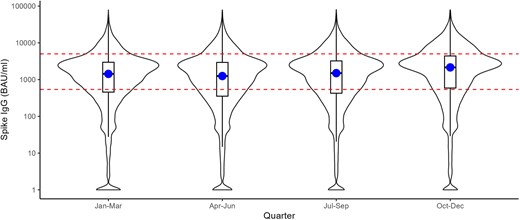
Violin plots of quantitative spike IgG levels by 3-month quarter among US blood donors, 2022. Filled circle represent the median levels. The box represents the middle 50% of the data (from the first to the third quartile), while the whiskers represent the smallest and largest values within 1.5 times the interquartile range (IQR) from the first and third quartiles, respectively. The dashed lines represent the levels associated with 50% protection (5010 BAU/mL) and 25% protection (540 BAU/mL) against first-time infections in the Cox proportional hazards model shown in Figure 2; this model was conducted among a subset of the study, as shown in Supplementary Figure 1. Abbreviations: BAU, binding antibody unit; IgG, immunoglobulin G.
During Q4 2022, people aged ≥ 65 years had the highest (2460 BAU/mL) and people aged 30–49 years had the lowest (980 BAU/mL) median S antibody concentration compared with other age groups (P < .0001; Supplementary Table 2). When comparing by immune status, people with hybrid immunity had the highest (2550 BAU/mL), people with vaccination-only–induced immunity had the next highest (1950 BAU/mL), and people with infection-only–induced immunity had the lowest (75 BAU/mL) median antibody concentrations during Q4 of 2022 (P < .0001). Spike antibodies were not detected in unvaccinated donors without infection-induced N antibodies (data not shown). A higher proportion of people aged 16–29 years had hybrid immunity than other age groups (P < .0001), and a higher proportion of people aged ≥65 years had vaccine-only–induced immunity than other age groups (P < .0001; Supplementary Figure 4A). Median antibody concentrations did not differ by sex, race, or ethnicity in clinically important ways, but these differences were statistically significant due to the large sample size. These comparisons differed by quarter (Supplementary Figures 5 and 6, and Supplementary Table 2).
Among the 142 599 donors in the cohort, 41 917 (29.4%) met inclusion criteria for the correlate of protection analysis (Supplementary Figure 1). Compared with the estimated incidence rate of infection among the unvaccinated donors (107.9 infections per 100 person years [PYs]), the rate among the vaccinated donors with reactive S IgG antibody concentrations was lower, ranging from 61.9 infections/100 PYs for those with S IgG antibody concentrations > 5000 BAU/mL to 101.9 infections/100 PYs for those with detectable S IgG antibody concentrations that were 17.8 to < 200 BAU/mL (Table 1). This translates to protection ranging from 6% (95% confidence interval [CI], 0%–11%) for those with S antibody concentrations 17.8 to < 200 BAU/mL to 43% (95% CI, 39%–47%) for those with S antibody concentration > 5000 BAU/mL. Vaccinated people with no detectable antibodies (< 17.8 BAU/mL) had an estimated protection of 11% (95% CI, 0%–22%). In the Cox proportional hazards model, protection increases with increasing S antibody concentration; approximately 540 BAU/mL (95% CI, 230–850 BAU/mL) was associated with 25% protection, and 5010 BAU/mL (95% CI, 4120–6550 BAU/mL) was associated with 50% protection (Figure 2).
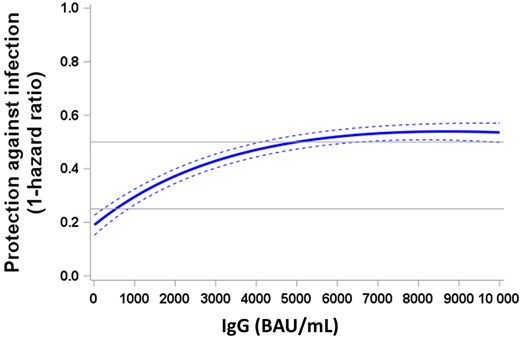
Protection against first-time infection by quantitative spike IgG antibody during 2022 among US blood donors. The solid line represents the modelled protection against first-time infection by quantitative S IgG antibody during 2022 among vaccinated US blood donors. The horizontal solid lines illustrate 25% and 50% protection thresholds. From a Cox proportional hazard model, protection was estimated as 1 − the hazard ratio with S antibody level as time varying covariate. The association of S antibody levels with hazard rate was modelled using as a spline function. Abbreviations: BAU, binding antibody unit; IgG, immunoglobulin G; S, spike.
Among all donors in the cohort, the proportion that had an antibody concentration > 5010 BAU/mL (ie, associated with > 50% protection) increased from 12.1% in Q1 to 18.3% in Q4 (P < .0001), and the proportion that had an antibody concentration > 540 BAU/mL (ie, associated with >25% protection) decreased from 70.4% in Q1 to 70.2% in Q4 (P < .0001; Supplementary Table 2).
In the secondary analysis that included data from each US state, higher state Q2 2022 median S antibody concentrations among donors aged > 60 years were weakly correlated with lower state Q3 2022 COVID-19 hospitalization rates among adults > 60 years (ρ = 0.13, P < .05; Supplementary Figure 7B). Higher Q2 state vaccination rates (received primary COVID-19 vaccine series) also correlated with lower Q3 2022 COVID-19 hospitalization rates, but the correlation was weaker (ρ = 0.07, P < .05; Supplementary Figure 7B). Data for other quarters demonstrated similar patterns (not shown).
DISCUSSION
Trends in population-level S quantitative antibody concentrations reflect the combined effects of waning antibody concentrations over time and boosting of antibodies from vaccination or infection. This study suggests that despite decreased uptake of booster vaccination doses in 2022 compared with the primary series [17], the population-level immunity, as measured by quantitative S IgG binding antibody titers, increased moderately during 2022. This is likely due to interaction of persistent memory B-cell and plasma-cell responses to additional SARS-CoV-2 antigen exposure, SARS-CoV-2 infections, modest COVID-19 vaccine uptake, and decreased S IgG concentration waning after multiple infections and vaccine doses [18, 19].
No clinically important differences in S IgG concentrations were seen by demographic groups, including age, sex, race, and ethnicity. This may be due to certain groups having higher vaccination rates (eg, older adults and non-Hispanic Asian people) while other groups have higher infection rates (eg, younger adults and Hispanic people) [20, 21], resulting in overall similar concentrations. In this study, people with prior vaccination, especially those with hybrid immunity, had much higher S IgG concentrations than people with infection-only–induced immunity. These findings reflect population averages, and antibody concentrations are influenced by total number of infections, vaccine doses, and amount of time from these immune-modifying events [19]. It is possible that those with hybrid immunity and vaccine-induced immunity have more cumulative immune-modifying events than those with infection-only–induced immunity, but those detailed data were not available for this analysis. Additionally, the amount of protection corresponding to a given antibody concentration can differ depending on history of prior infection and vaccination [22].
This study illustrated that higher S IgG antibody concentrations correlated with increased protection against first infections. While numerous studies have shown that increased S neutralizing and binding antibody concentrations are correlated with a decreased risk of symptomatic COVID-19 [5], this study is unique in that the outcome was serologic-defined infection, which includes asymptomatic infections. A low amount of protection was detected among vaccinated persons even with minimal or undetectable antibodies, although this was not statistically significant; this is possibly related to cellular immunity or differences in behavior of vaccinated and unvaccinated people. The model in this study reflects population averages and does not establish an antibody threshold above which a person is absolutely protected from infection. The CIs of this study's Cox model reflect the precision of the model's estimates, but predicting an individual's protection using S IgG would be subject to more variability and would need to reflect the assay's precision [23]. Additionally, the secondary analysis of this study suggests that blood donor US state-level median S IgG concentrations correlate more with state-level hospitalizations than vaccine rates, likely because S IgG levels incorporated both vaccine-induced and infection-induced antibodies.
There are several limitations to this study. Blood donors are largely healthier than the general population and potentially have higher vaccination rates, and results may not be generalizable [20, 24]. Vaccinated people may practice increased precautions (eg, wearing face masks, avoiding crowded gatherings) than unvaccinated people, potentially biasing results [25]. However, the dose response relationship of higher antibody levels corresponding with increased protection supports the validity of the results. This study focused on ancestral S IgG concentrations, and binding and neutralizing assays that match the SARS-CoV-2 variant circulating (eg, BA.1.1, BA.4, BA.5 during 2022) may correlate better with protection [5, 7]. Additionally, other parts of the immune system, such as mucosal immunity and cellular immunity, are important components of protection against infection and severe disease [26, 27].
The correlate of protection analysis was limited to people without known prior infection as evidenced by detectable N antibodies. Levels of S antibody correlated with 25% and 50% protection were added to multiple figures to contextualize population antibody levels, but caution is needed when applying the antibody thresholds to the entire cohort or the general population. By the end of 2023, an estimated 87% of adults in the United States had detectable N antibodies [28]. The level of protection against SARS-COV-2 infection associated with specific S antibody concentrations can differ depending on a person's history of infection and vaccination. For example, some studies have shown higher protection for a given antibody level with infection-induced immunity than with vaccine-induced immunity, and shown higher protection when infected with a more recent variant than when infected with an older variant [22, 29]. Additional analyses incorporating infection-induced and hybrid immunity, and estimated protection against reinfections are needed. Furthermore, correlates of protection against symptomatic and severe COVID-19 likely differ with a lower antibody threshold needed for protection against more severe outcomes [27]. Future studies of this cohort incorporating reinfection and severe disease are in progress.
During 2022, this nationwide study showed stable to mildly increased S IgG concentrations among blood donors. Higher antibody concentrations were associated with increased levels of protection against infection following vaccination. These persistently high S antibodies likely contributed to decreased risk of severe disease or death despite periodic surges in SARS-CoV-2 infections [2]. These results support CDC Respiratory Virus Guidance, including to stay up to date with COVID-19 vaccines, which is the safest way to maintain COVID-19 immunity [30].
Supplementary Data
Supplementary materials are available at The Journal of Infectious Diseases online (http://jid.oxfordjournals.org/). Supplementary materials consist of data provided by the author that are published to benefit the reader. The posted materials are not copyedited. The contents of all supplementary data are the sole responsibility of the authors. Questions or messages regarding errors should be addressed to the author.
Notes
Author contributions. J. M. J., E. G., I. L., M. S., B. R. S., M. M. C., M. B. H., J. O., D. J. W., M. P. B., and B. J. B. conceived and designed the analysis. E. B., M. S., B. R. S., M. C. L., M. P. B., V. G., and P. S. collected the data. E. G., I. L., A. A., M. M., J. O., and D. J. W. performed the analysis. J. M. J., I. L., and D. J. W. wrote the paper. J. M. J., R. V. F., J. O., and M. P. B. contributed project management. J. M. J., E. G., I. L., M. S., B. R. S., A. A., I. M. M., R. V. F., V. G., B. J. B., M. M. C., M. B. H., M. C. L., J. O., D. J. W., and M. P. B. reviewed and contributed to manuscript:
Financial support. This work was supported by the Centers for Disease Control and Prevention (research contract number 75D30120C08170 with M. P. B.).
Data availability. Aggregate vaccine- and infection-induced seroprevalence data are available at https://data.cdc.gov/Laboratory-Surveillance/2022–2023-Nationwide-Blood-Donor-Seroprevalence-Su/ar8q-3jhn. Individual and quantitative spike IgG antibody data are not publicly available.
References
Author notes
Presented in part: Advisory Committee on Immunization Practices Meeting, Atlanta, Georgia, 23 June 2023; and Individual and Population Immunity to Respiratory Viruses Conference, Hong Kong, 8–10 November 2023.
Potential conflicts of interest. All authors: No reported conflicts. All authors have submitted the ICMJE Form for Disclosure of Potential Conflicts of Interest. Conflicts that the editors consider relevant to the content of the manuscript have been disclosed.


