https://orcid.org/0000-0002-1736-1350
Abstract
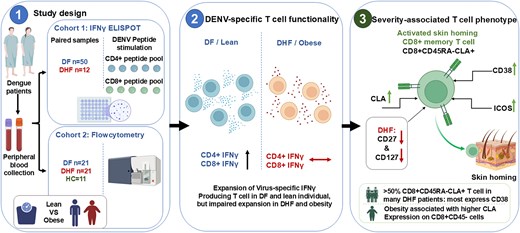
Currently, the role of dengue virus-specific T-cell responses in disease pathogenesis and protection is not well understood, including potential differences in individuals with obesity. We sought to investigate the functionality and phenotype of T cells in patients with acute dengue fever (DF) or dengue haemorrhagic fever (DHF). T-cell function was assessed in paired samples (first sample on ≤4 days and second 5–6 days since onset of illness) in patients with DF (n = 50) and DHF (n = 12), using 109 peptides representing CD8+ epitopes and 90 peptides targeting CD4+ T-cell epitopes. Phenotypic analysis was performed in patients with DF (n = 21) and DHF (n = 21), recruited between days 6 and 8 since onset of illness, using multicolor flow cytometry. The frequency of ex vivo IFNγ ELISpot responses to both the CD4+ and CD8+ peptide pools significantly increased from first (F) to second (S) time point in patients with DF (P < 0.0001) but not with DHF. The frequency of ex vivo IFNγ ELISpot responses to CD4+ (P = 0.001) and CD8+ peptide pools (P = 0.0002) also significantly increased from the F to S in lean patients but not in obese patients. Cutaneous lymphocyte-associated antigen (CLA) expression was significantly higher in the CD8+ T-cell subset in patients with DF and DHF compared to healthy controls, and these differences were most significant in CD8+ CD45RA− T cells. CD8+ CD45RA−CLA+ T cells consisted of >50% of the T cells in 9/21 patients with DHF, with 92.7% expressing CD38. CLA expression was highest in the CD8+ CD45RA− T cells in obese individuals, which was significantly higher compared to lean individuals (P = 0.01). CD27 and CD127 were both significantly downregulated in patients with DHF compared to DF, with ICOS expression being significantly higher in CD8+ T cells in DHF. Patients with DHF and obese individuals had impaired T-cell functionality compared to patients with DF and lean individuals, with an expansion of activated, skin-homing CD8+ T cells exhibiting downregulation of CD27 and CD127. Our data suggest a contributory role of dysfunctional skin-homing T cells in disease pathogenesis, meriting further investigation.