Journal Article

Unraveling complement activation profiles on endothelial cells in healthy donors using an ex vivo model

Get access
Clinical and Experimental Immunology, Volume 220, Issue 1, 2026, uxaf082, https://doi.org/10.1093/cei/uxaf082
Published:
24 December 2025
Article history
Received:
06 April 2025
Revision received:
30 October 2025
Accepted:
25 November 2025
Published:
24 December 2025

Abstract

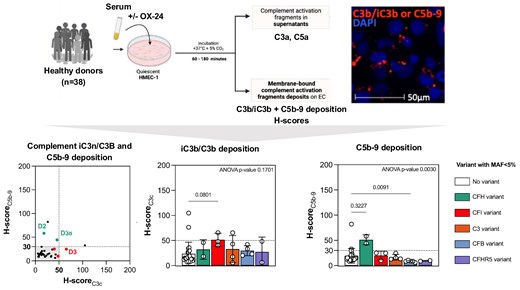
Functional approaches to properly examine individual’s susceptibility to complement dysregulation are limited. We assessed ex vivo complement activation induced by sera from 38 healthy donors on resting microvascular endothelial cells with or without complement dysregulation (OX-24 monoclonal antibody). Following incubation, immunofluorescence was used to quantify membrane-bound C3b/iC3b and C5b-9 with a computer-assisted method (H-score). C3a and C5a anaphylatoxins were quantified in supernatants by ELISA. Genetic sequencing of 32 donors was also performed to identify variants in alternative pathway genes. Elevated complement deposition was defined by H-scoreC3c > 50 and/or H-scoreC5b-9 > 30. Combined analysis of C3b/iC3b and C5b-9 deposition in 35 donors showed that one donor (2.8%) had an isolated increase in C3b/iC3b deposits, three (8.6%) had an isolated increase in C5b-9 deposits, and one (2.8%) had both increased C3b/iC3b and C5b-9 deposition. Genetic analysis revealed three heterozygous rare/low frequency missense variants in CFH (p.N1050Y, p.R1210C) and CFI (p.A76G) in 3/5 donors with increased complement deposition. This model revealed distinct patterns of complement activation among healthy individuals and identified a genetic basis for dysregulation in three cases. This assay offers a promising tool to study complement activity and its mechanisms in research.
This article is published and distributed under the terms of the Oxford University Press, Standard Journals Publication Model (https://dbpia.nl.go.kr/pages/standard-publication-reuse-rights)
You do not currently have access to this article.

Supplementary data

Close
This Feature Is Available To Subscribers Only

Sign In or Create an Account

Close

This PDF is available to Subscribers Only

View Article Abstract & Purchase Options

For full access to this pdf, sign in to an existing account, or purchase an annual subscription.

Close

Gift article access

As a benefit of your subscription, you can share temporary access to restricted articles.

Each link will stop working after 30 days or 10 uses. You may create up to 10 links in a 30 day period.

Please sign in to your personal account to gift article access.

Gift article access

Please create a link below to share with others. This will provide temporary access to this restricted article.

The link will stop working after 30 days or 10 uses. You may create up to 10 links in a 30 day period.

Gift articles remaining: --

Gift article access

The link will stop working after 30 days or 10 uses. You may create up to 10 links in a 30 day period.

Gift articles remaining: --

Gift article access

As a benefit of your subscription, you can share temporary access to restricted articles.

Each link will stop working after 30 days or 10 uses.

You have reached the limit of 10 links within a 30 day period