


This scientific commentary refers to ‘Expansion of GGC repeat in human-specific NOTCH2NLC gene is associated with essential tremor’ by Sun et al. (doi: ).
The family of repeat expansion disorders currently comprises over 30 members, more than half of which were discovered in the 1990s (Fig. 1) (Bahlo et al., 2018; Paulson, 2018). The advent of second-generation sequencing allowed the genetic basis of many other human diseases to be unravelled over the next 15 years using high-throughput technologies. However, these technologies were confined to short-read sequencing and were inefficient at detecting structural variants, including repeat expansions. More recently, new methods have emerged for the detection of repeat expansions including third-generation sequencing that provides longer, continuous sequences. This has resulted in a renaissance of research into the genetic basis of repeat expansion disorders and the discovery of eight novel pathogenic repeats in the last 3 years (Fig. 1). Among these, expanded GGC repeats in the non-coding region at the very beginning of the NOTCH2NLC gene have been shown by three independent research groups to cause neuronal intranuclear inclusion disease (NIID) (Ishiura et al., 2019; Sone et al., 2019; Tian et al., 2019). NIID is a complex sporadic or dominantly inherited neurodegenerative disorder, presenting with a wide range of ages at onset (AAO; infancy to adulthood) and with various combinations of dementia, parkinsonism, cerebellar ataxia, and peripheral neuropathy. Neuroimaging and neuropathological hallmarks of NIID include high-intensity signals in diffusion-weighted imaging in the corticomedullary junction and eosinophilic hyaline intranuclear inclusions (seen in the nervous system, other tissues, and skin biopsies). In this issue of Brain, Sun and co-workers report a fourth discovery of expanded GGC repeats in NOTCH2NLC, this time in patients with essential tremor (Sun et al., 2020).
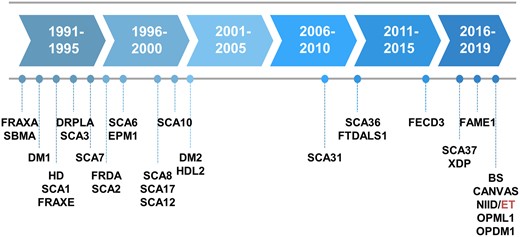
A timeline of the discovery of repeat expansion diseases. Disorders caused by short and stable polyalanine tract duplications/expansions were not considered here because of their intrinsically different nature and disease mechanism. BS = Baratela-Scott syndrome; CANVAS = cerebellar ataxia, neuropathy, vestibular areflexia syndrome; DM1 = myotonic dystrophy 1; DM2 = myotonic dystrophy 2; DRPLA = dentatorubral-pallidoluysian atrophy; EPM1 = myoclonic epilepsy Unverricht Lundborg; ET = essential tremor; FAME1 = familial adult myoclonic epilepsy; FECD3 = Fuchs endothelial corneal dystrophy; FRAXA = fragile X syndrome (fragile-X site A-associated intellectual disability); FRAXE = fragile-X site E-associated intellectual disability; FRDA = Friedreich's ataxia; FTDALS1 = frontotemporal dementia and/or amyotrophic lateral sclerosis; HD = Huntington's disease; HDL2 = Huntington's disease-like 2; NIID = neuronal intranuclear inclusion disease; OPDM1 = oculopharyngodistal myopathy 1; OPML1 = oculopharyngeal myopathy with leukoencephalopathy 1; SBMA = spinal and bulbar muscular atrophy; SCA = spinocerebellar ataxia.
Sun et al. began by using linkage analysis to narrow down the linked region of the NOTCH2NLC gene in two essential tremor families, before performing whole-exome sequencing (WES) in two affected members of each of the families. Given that this approach failed to identify any potential pathogenic variants, they then used long-read (third-generation) WES to search for a disease-causing structural variant. Upon examining the resulting long reads, Sun et al. detected expansion of GGC repeats in NOTCH2NLC in all available affected individuals from both pedigrees. This led them to examine NOTCH2NLC repeat length in 195 additional essential tremor families, whereupon they discovered that patients from nine of these families also carried expanded GGC repeats. The authors therefore concluded that poly-GGC expansions accounted for 5.6% (11/197) of familial essential tremor in their series. The number of GGC repeats in 27 affected individuals from all 11 pedigrees ranged from 60 to 250 (Fig. 2), compared to 7–23 in unaffected family members. Among over 1300 screened controls, the authors detected 4–41 repeats, in keeping with previous reports (Ishiura et al., 2019; Sone et al., 2019; Tian et al., 2019).
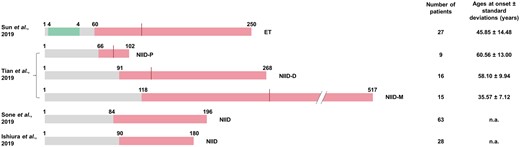
Length of GGC repeat expansions in the NOTCH2NLC gene reported in patients with essential tremor and NIID. The expanded repeat ranges reported to date in patients are shown in red, and those in controls are shown in green. The vertical red lines represent the average number of repeats. ET = essential tremor; NIID-D = dementia-dominant subtype of NIID; NIID-M = muscle-weakness-dominant subtype of NIID; NIID-P = parkinsonism-dominant subtype of NIID.
To investigate the relationship between NIID and essential tremor, Sun and colleagues compared GGC repeat lengths and AAOs in the essential tremor patients in their cohort and in the NIID patients described by Tian et al. (2019). The latter were further subgrouped according to their dominant phenotype into parkinsonism NIID (NIID-P), dementia NIID (NIID-D), and muscle weakness NIID (NIID-M). The ranges of GGC repeat numbers and their means were not significantly different between essential tremor and NIID-D and NIID-P patients (Fig. 2). Of note, the GGC repeat ranges reported by Sone et al. (2019) and Ishiura et al. (2019) were narrower, but were still within the limits of the repeat range observed in patients with essential tremor (Fig. 2). On the other hand, NIID-M patients had a considerably wider range of GGC repeat numbers and, consequently, a significantly higher mean number of repeats in comparison to individuals with essential tremor (Fig. 2). In agreement with the observation in other repeat expansion disorders that repeat numbers are negatively correlated with AAO (Westenberger et al., 2019), the mean AAO of NIID-M patients was significantly lower than that of essential tremor patients. Conversely, the mean AAOs of both NIID-P and NIID-D patients were significantly higher than the mean AAO of essential tremor patients. In further accordance with other repeat expansion diseases, offspring tended to be affected on average more than 10 years earlier than their parents. However, the difference in mean repeat number between these two subgroups was not statistically significant (possibly due to the small number of individuals in each generation), nor were there differences in clinical scores obtained with the Essential Tremor Rating Assessment Scale (TETRAS).
The stretch of GGC repeats in NOTCH2NLC is not pure: in the reference human genome sequence it consists of 11 GGC repeats interrupted by two GGA trinucleotides [(GGC)9(GGA)2(GGC)2]. Sun and colleagues investigated the structure of the expanded repeats in essential tremor patients and noticed that the frequency of GGA interruptions was considerably lower than in NIID patients. This difference was particularly pronounced in the NIID-M subgroup of patients whose NOTCH2NLC repeats are especially enriched with GGA trinucleotides (Sone et al., 2019; Tian et al., 2019). Interruptions in various expanded repeats investigated to date have been shown to modify (i) AAO (Pešović et al., 2018) or clinical presentation (Charles et al., 2007) of the respective diseases; and (ii) the stability of the repeat (Cumming et al., 2018). Thus, it is conceivable that the position and frequency of non-GGC repeats in NOTCH2NLC drive the resulting phenotype. Although interruptions typically stabilize the repeats and prevent their further expansion (Cumming et al., 2018), the frequency of GGA trinucleotides is highest in NIID-M patients found to harbour the longest repeat stretches in NOTCH2NLC (Sone et al., 2019; Tian et al., 2019). Considering the potential prognostic implications, this finding warrants further investigation.
When comparing clinical features of their GGC repeat expansion-positive and -negative essential tremor patients, Sun et al. noted that TETRAS-I and TETRAS-II scores of patients with expansions were significantly higher than those of patients with a normal repeat range, indicating that expansions may elicit a more severe tremor phenotype and greater impairment in activities of daily living. The likelihood of tremor involving head, trunk, and limbs was comparable in both groups; however, patients with GGC expansions were more likely to suffer from voice tremors. Otherwise, the 27 essential tremor patients with NOTCH2NLC trinucleotide expansions manifested with simple kinetic and/or postural tremor, without cognitive impairment, peripheral neuropathy, or cerebellar ataxia. Although brain MRI findings were unremarkable in all of the investigated individuals, NIID-characteristic nuclear inclusions were present in fibroblasts of all three essential tremor patients with GGC expansions who underwent skin biopsy.
In light of all of the above, Sun and colleagues posed the key question: are their clinically diagnosed essential tremor patients, carrying GGC expansions in NOTCH2NLC, actually affected by NIID? Or are they manifesting a related but different disease entity? Clinical reassessment of patients upon genetic testing did not extend the initial diagnosis. Patients presented with a simple kinetic and/or postural tremor and without any signs of NIID such as cognitive impairment, autonomic dysfunction, cerebellar ataxia, pyramidal signs, or paroxysmal loss of consciousness. Another study that identified GGC expansions in NOTCH2NLC in three families with Parkinson’s disease and two with Alzheimer’s disease likewise confirmed the presence of classic phenotypes of these two disorders (Tian et al., 2019). Brain MRI and EMG performed by Sun et al. revealed no severe brain leukodystrophy, cerebellar atrophy, or peripheral neuropathy in the repeat-carrying essential tremor patients. However, as the authors rightfully point out, without post-mortem histopathological investigation, the presence of neurodegeneration and a diagnosis of NIID cannot be excluded.
It is indeed plausible that NOTCH2NLC-related essential tremor and NIID are distinct disorders instigated by different molecular mechanisms. Such pleiotropy is exemplified by fragile X syndrome, an infant-onset neurodevelopmental condition, and fragile X-associated tremor ataxia syndrome, an adult-onset neurodegenerative disease. Both conditions result from repeat expansions in the FMR1 gene but, because of different repeat lengths, have distinct underlying pathogenic mechanisms. Alternatively, as discussed above, a genetic modifier may be responsible for the variable expressivity of NIID presenting in some cases as pure essential tremor. This idea is illustrated by spinocerebellar ataxia type 2 (SCA2) where interruptions in SCA2-associated expanded repeats cause a pure parkinsonian phenotype (Charles et al., 2007).
First-, second-, third-generation sequencing: Step-wise improved methods for determining the order of nucleotides (sequence) in a target DNA molecule. Initial first-generation sequencing methods could ‘read’ only about 1000-nucleotide-long sequences. Second-generation sequencing can provide much longer sequences (even entire genomes) by simultaneous generation and subsequent alignment of large numbers of short reads. Third-generation sequencing can produce continuous reads of more than 2 million nucleotides from individual DNA strands.
Repeat expansion disorders: A group of disorders caused by an unstable expansion (increase in number) of short tandem repeats above a disease-specific threshold.
In conclusion, recent advances in DNA sequencing technology have resulted in a renewed burst of repeat expansion disorder discovery. This latest addition, GGC expansion in the NOTCH2NLC gene, was discovered in four independent studies, three investigating the genetic basis of NIID and one that of essential tremor. The latter, reported by Sun and colleagues in this issue of Brain, raises questions with important clinical implications: Does the phenotype of NIID include essential tremor, or can essential tremor be caused by repeat expansions in NOTCH2NLC, indicating that it represents a neuropathologically distinct condition? The future will reveal whether Sun and co-authors have uncovered the very first monogenic aetiology of essential tremor.
Funding
A.W. and C.K. are supported by the German Research Foundation (DFG; FOR 2488).
Competing interests
The authors report no competing interests.
References


