


 https://orcid.org/0000-0002-0000-8876

Abstract
Background
Cryptococcosis remains a leading cause of HIV-associated mortality globally. Cytomegalovirus (CMV) viremia is common in advanced HIV disease and is associated with excess mortality through unclear mechanisms. We assessed if CMV viremia is associated with slower rates of Cryptococcus clearance from cerebrospinal fluid (CSF) in persons being treated for HIV-associated cryptococcal meningitis.
Methods
We quantified baseline CMV DNA using PCR from cryopreserved plasma in adults with cryptococcal meningitis in Uganda from 2010 to 2024. The early fungicidal activity (EFA) was calculated as the negative slope of log10 Cryptococcus colony-forming units (CFU)/mL CSF/day over 18 days. We compared fungal burden, EFA, proportions achieving CSF sterility, and 18-week mortality by CMV status.
Results
Among 508 participants, 37% had detectable CMV viremia. Median EFA was lower in those with CMV viremia (0.31 vs 0.35 log10 CFU/mL/day; P = .03), with a greater proportion having EFA < 0.20 CFU/mL/day (30.5% vs 22.4%; P = .04) and with fewer achieving CSF sterility by day 18 (36% vs 54%; P < .001) than those without CMV viremia. Mortality at 18 weeks was higher in CMV viremic participants (43% vs 26%; P < .001). Participants with both CMV viremia and EFA < 0.20 had 2.5-fold increased hazard of death compared with those without CMV viremia and with EFA ≥ 0.20 (adjusted hazard ratio = 2.48 [95% CI, 1.52–4.06]). No interaction with antifungal treatment was observed.
Conclusions
Cytomegalovirus viremia is associated with impaired CSF fungal clearance and increased mortality in HIV-associated cryptococcal meningitis—potentially supporting an immunomodulatory role. Further investigation into the underlying immune response in HIV-CMV co-infection is warranted.
Central nervous system infection due to Cryptococcus is the most common cause of HIV-associated meningitis in Uganda and remains a significant source of morbidity and mortality worldwide in persons with advanced HIV disease [1–3]. Despite important advances in optimizing antifungal regimens, mortality at 10 weeks still exceeds 20% in low- and middle-income countries (LMIC). One predictor of mortality in HIV-associated cryptococcal meningitis is the rate of fungal clearance from the cerebrospinal fluid (CSF), termed early fungicidal activity (EFA). Early fungicidal activity is calculated by determining the change in log10 Cryptococcus colony-forming units (CFU) per mL of CSF per day of therapy. We have previously shown that CSF fungal clearance slower than 0.20 log10 CFU/mL/day is associated with increased risk for mortality [4]. Given the association with mortality, there is a need to investigate factors affecting EFA beyond antifungal regimen.
Persons with advanced HIV disease are additionally at risk for complications from reactivation of latent Herpesviridae, such as cytomegalovirus (CMV), Ebstein–Barr virus (EBV), herpes simplex virus, and varicella zoster virus. Cytomegalovirus seroprevalence is nearly universal in adults living with HIV in LMIC settings, putting this population at risk for CMV reactivation as CD4+ T-cell counts decrease [5]. We have demonstrated baseline prevalence rates of active CMV viremia between 36% and 52% in Ugandans with HIV-associated cryptococcal meningitis. These studies demonstrated ∼1.6–3.2-fold greater hazard of death in persons with any baseline CMV viremia compared to those without detectable CMV viremia [5, 6]. In cohorts across multiple countries, the risk of mortality increases with higher CMV viral loads ≥ 1000 IU/mL [7, 8]. However, an important unresolved knowledge gap is whether CMV viremia is driving the observed mortality trend or is instead a biomarker of profound immune dysfunction in persons with advanced HIV disease [9].
Investigations into mechanisms of deleterious effects associated with CMV in persons with HIV-associated cryptococcal meningitis are warranted. Cytomegalovirus viremia has been associated with increased rates of fungal infections in kidney transplant recipients [10], hematopoietic stem cell transplant [11], and immunosuppressed patients with rheumatologic disease [12]. Further, a randomized clinical trial of prophylactic high-dose valacyclovir versus placebo in kidney transplant recipients demonstrated significantly fewer fungal and bacterial infections in the valacyclovir group [13]—suggesting a causal effect. Thus, we hypothesized that active CMV replication (ie, viremia) might impact the clinical course of cryptococcal meningitis through modulation of host–pathogen interactions leading to enhanced fungal pathogenesis. While an extensive immunological investigation is beyond the scope of this manuscript, CMV has the well-described ability to confer immunomodulatory functions on the infected host. The specific goal of this manuscript is to investigate if CMV viremia is associated with impaired CSF clearance of Cryptococcus, which is a known risk factor for mortality [4], and may represent an end result of host immunomodulation.
METHODS
Study Population and Setting
From 2010 to 2024, we prospectively enrolled adults (≥18 years) with HIV-1 and associated cryptococcal meningitis from 3 tertiary referral hospitals in Uganda: Mulago National Referral Hospital and Kiruddu National Referral Hospital in Kampala and Mbarara Regional Referral Hospital in Mbarara, Uganda. Diagnosis was made by CSF cryptococcal antigen (IMMY, Norman, Oklahoma) [14]. A fungal culture was sent from each lumbar puncture, and Cryptococcus was quantified in CFUs using established protocols [15]. Participants received amphotericin-based induction therapy for treatment of cryptococcal meningitis with standardized supportive care including electrolyte monitoring/replacement and therapeutic lumbar punctures to control elevated intracranial pressure as needed. Participants included in this analysis were enrolled into a mix of observational and randomized controlled trials including: testing ART timing [16], testing adjunctive sertraline [17], testing oral amphotericin [18], as well as observational cohorts [19, 20]. Induction therapy changed over time as international standards were updated, initially consisting of amphotericin B plus fluconazole-based regimens, before transitioning to amphotericin B plus flucytosine-based regimens in 2019.
DNA Extraction and Polymerase Chain Reaction (PCR)
We quantified CMV DNA concentrations from cryopreserved samples from all study participants with plasma available for testing. Cryopreserved samples were shipped to the University of Minnesota where CMV DNA quantification was performed. We performed DNA extraction from 200 µL of plasma or serum using the QIAcube HT (QIAGEN, Hilden, Germany) and QIAamp 96 Virus DNA QIAcube kit according to the manufacturer's instructions. Multiplex qPCR was performed using the LightCycler 480 System (Roche, Basel, Switzerland) and UL83 targeted primers [21]. Detailed PCR methods can be found in the Supplementary Methods section. Laboratory staff processed de-identified samples and were blinded to participant data and outcome. Cytomegalovirus DNA quantification in copies/mL values were converted to international units (IU)/mL using the WHO International Standard for Human Cytomegalovirus for Nucleic Acid Amplification Techniques (NIBSC code 09/162) as controls for CMV viral load [22].
Statistical Analysis
We defined CMV viremia as any quantity of CMV DNA in plasma above the threshold of PCR detection, which was 77 IU/mL for our assay [22, 23]. For this study, we considered any sample within 3 days of meningitis diagnosis as a baseline sample. Baseline characteristics were compared by CMV viremia status using χ² or Kruskal–Wallis testing.
The primary outcome in our analysis was EFA, which was calculated as the negative slope change in quantitative CSF fungal burden (log10 CFU/mL) over the first 18 days of therapy, estimated by linear regression of all available measurements within that interval. Participants who did not have at least 2 quantitative culture results available within the first 18 days were excluded as they did not have a calculable EFA. Similarly, participants with sterile CSF (ie, without fungal growth) at baseline were excluded from the primary analysis insofar as they could not contribute to EFA analyses, but these are separately described by CMV status in the supplement (Supplementary Results). We determined the proportion of participants who achieved sterility by day 18 stratified by baseline CMV viremia status. All-cause mortality through 18 weeks was analyzed with survival curves for groups formed by CMV viremia status at baseline and EFA. We reported odds ratios and hazard ratios with 95% confidence intervals (95% CI), and P values for multivariate logistic and Cox regressions, which adjusted for CD4 count, CSF white cell count, baseline CSF fungal burden, and fluconazole backbone versus flucytosine backbone eras of antifungal therapy. All statistical analyses were performed in SAS version 9.4 (SAS Institute, Cary, North Carolina, United States). A P value of ≤.05 was considered statistically significant.
RESULTS
We included a total of 508 participants with cryptococcal meningitis who had both plasma CMV viral load measurement and EFA through 18 days available (Supplementary Figure 1). The cohort had a median age of 35 years (interquartile range [IQR], 30–41) and was comprised of 40% (204/508) women. The majority of participants were ART naïve (69% [352/508]) at time of cryptococcal meningitis diagnosis. Overall, 187 (37%) had any detectable CMV DNA in baseline blood samples, with a median CMV viral load of 418 IU/mL (IQR, 141–3301; max, 902 700). The median CD4 count was 12 cells/μL (IQR, 6–38) for those with CMV viremia versus 19 cells/μL (8–54) for those without CMV viremia (P = .002). Participants with CMV viremia had higher baseline quantitative burdens of Cryptococcus on CSF culture versus participants without CMV viremia (88 000 vs 37 500 CFU/mL CSF; P < .001). Persons with CMV viremia were also more likely to lack CSF pleocytosis with white blood cells ≤ 5 cells/μL and were more likely to have lower hemoglobin levels. Baseline characteristics by any detectable CMV viremia are compared in Table 1.
Baseline Characteristics by CMV Viremia Status
| Baseline Characteristic | CMV Viremia Present | CMV Viremia Absent | P Value |
|---|---|---|---|
| N per group | 187 | 321 | |
| Women | 83 (44%) | 121 (38%) | .14 |
| Age, years | 35 [30, 40] | 35 [30, 41] | .87 |
| Blood CD4+ T cells/µL | 12 [6, 38] | 19 [8, 54] | .002 |
| CD4 < 50 cells/µL | 142 (81%) | 218 (73%) | .06 |
| CD4 unknown | 12 (6%) | 24 (8%) | −- |
| Receiving HIV therapy | 52 (28%) | 104 (32%) | .28 |
| Months on ART | 2.3 [0.6, 24] | 4.0 [0.9, 19] | .54 |
| CMV DNA, IU/mL | 418 [141, 3301] | −- | −- |
| Glasgow Coma Scale score < 15 | 59 (32%) | 95 (30%) | .64 |
| Hemoglobin, g/dL | 11.3 [9.8, 12.6] | 11.9 [10.4, 13.2] | .002 |
| CSF white cells ≤ 5 cells/µL | 132 (72%) | 163 (52%) | <.001 |
| CSF opening pressure, mmH2O | 270 [180, 380] | 260 [160, 380] | .41 |
| CSF quantitative culture, Cryptococcus CFU/mL CSF | 88 000 [10 400, 380 000] | 37 500 [1 800, 221 000] | <.001 |
Data are N (%) or median [interquartile range]. P values are χ² or Kruskal–Wallis testing.
Abbreviations: CMV, cytomegalovirus; ART, antiretroviral therapy; IU/mL, international units per milliliter; CSF, cerebrospinal fluid; TB, tuberculous.
We compared EFA through 18 days and the proportion achieving sterility through 18 days for persons with CMV viremia versus those without CMV viremia. The median EFA was 0.31 log10 CFU/mL/day (IQR, 0.17–0.44) in the CMV viremia group and 0.35 log10 CFU/mL/day (IQR, 0.22–0.51) in the no CMV viremia group (Table 2; Supplementary Figure 2). Cerebrospinal fluid culture sterility was achieved by 18 days in 36% of CMV viremic persons compared to 54% of CMV non-CMV viremic persons (P < .001). When we categorized participants by the clinically meaningful cutoff of EFA < 0.20 log10 CFU/mL/day, we found that 31% of those with CMV viremia had EFA < 0.20 log10 CFU/mL/day versus 22% of those without CMV viremia (P = .04). We noted that those with the highest CMV viral load tertile had the largest proportion (35.5%) of participants with EFA < 0.20 log10 CFU/mL/day, although the median EFA in this group was somewhat higher than the lowest tertile (Supplementary Table 1). Among those with an EFA ≥ 0.20, only 51% (66/130) of participants with CMV viremia achieved sterility compared with 67% (167/249) without CMV viremia (P = .002) (Supplementary Table 2). Of those with EFA < 0.20, 4% (2/57) of those with CMV viremia and 10% (7/72) of those without CMV viremia achieved sterility (P = .17). After adjustment for CD4 count, CSF white cell count, baseline CSF fungal burden, and antifungal era, CMV viremia remained significantly associated with failure to sterilize CSF by 18 days (aOR = 1.56; 95% CI, 1.03–2.35; P = .03) while trending strongly toward increased odds of EFA < 0.20 log10 CFU/mL/day (aOR = 1.52; 95% CI, .97–2.40; P = .07) (Table 3).
Key Outcomes by CMV Viremia Status
| Outcome | CMV Viremia Present (N = 187) | CMV Viremia Absent (N = 321) | P Value |
|---|---|---|---|
| EFA, log10 CFU/mL/d | |||
| Mean (95% CI) | 0.37 (0.30, 0.43) | 0.43 (0.39, 0.48) | .11 |
| Median (IQR) | 0.31 [0.17, 0.44] | 0.35 [0.22, 0.51] | .03 |
| EFA < 0.20 log10 CFU/mL/d | 57 (31%) | 72 (22%) | .04 |
| CSF sterile by day 18 | 68 (36%) | 174 (54%) | <.001 |
| Death by week 18 | 80 (43%) | 83 (26%) | <.001 |
| Death by day 30 | 47 (25%) | 52 (16%) | .01 |
Values are mean (95% CI), median [IQR], or N (%). Early fungicidal activity calculated using all cultures through 18 d. P values are via χ², Kruskal–Wallis, or Linear Regression, as appropriate.
Abbreviations: EFA, early fungicidal activity; CFU, colony-forming units; 95% CI, 95% confidence interval; IQR, interquartile range; CSF, cerebrospinal fluid.
Multivariable Logistic Regression for Predictors of Poor Fungal Clearance
| Outcome | Predictors | Odds Ratio (95% CI) | P Value |
|---|---|---|---|
| EFA < 0.20, log10 CFU/mL/d | |||
| CMV detectable | 1.52 (.97, 2.40) | .07 | |
| CD4 cell count (per 20 cell increase) | 0.85 (.75, .97) | .02 | |
| CSF WBC ≤ 5 cells/µL | 1.25 (.77, 2.02) | .37 | |
| CSF quantitative culture (per log10 CFU) | 0.75 (.63, .89) | <.001 | |
| Failure to sterilize CSF by day 18 | |||
| CMV detectable | 1.56 (1.03, 2.35) | .03 | |
| CD4 cell count (per 20 cell increase) | 0.90 (.82, .99) | .03 | |
| CSF WBC ≤ 5 cells/µL | 1.46 (1.24, 1.70) | <.001 | |
| CSF quantitative culture (per log10 CFU) | 1.66 (1.10, 2.51) | .02 |
Abbreviations: EFA, early fungicidal activity (log10 CFU/mL/d); CSF, cerebrospinal fluid; WBC, white blood cells; CFU, colony-forming units.
Mortality at 18 weeks was 43% (80/187) in those with CMV viremia versus 26% (83/321) in those without CMV viremia (P < .001; Table 2). The hazard ratio for 18-week mortality for CMV viremic persons was 1.84 (95% CI, 1.35–2.50) compared to non-viremic persons (P = .001). Figure 1 demonstrates survival probability through 18 weeks across dichotomized groups of detectable CMV viremia and an EFA cutoff of 0.20 log10 CFU/mL/day. The most favorable 18-week mortality was seen in the group with no detectable CMV and EFA ≥ 0.20 log10 CFU/mL/day (25% [61/249]). The highest mortality was seen in the group with detectable CMV and EFA < 0.20 log10 CFU/mL/day (47% [27/57]). Participants with CMV viremia and EFA < 0.20 log10 CFU/mL/day had a ∼2.5-fold increased hazard of death compared to those without CMV viremia and EFA ≥ 0.20 (adjusted hazard ratio = 2.48; 95% CI, 1.52–4.06; P < .001), after multivariable adjustment (Table 4).
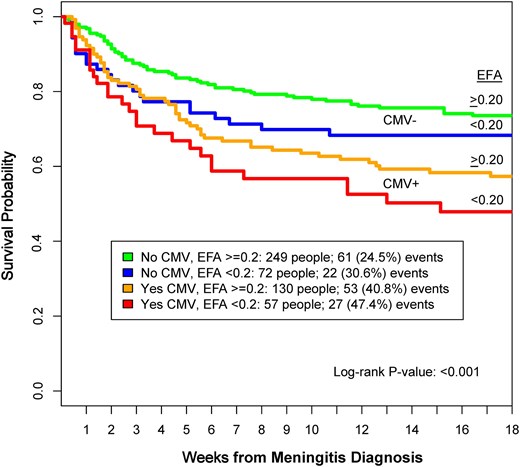
Kaplan–Meier for 18-wk mortality by CMV viremia and EFA groupings. This figure demonstrates survival probability through 18 wk stratified by the categorical presence of CMV viremia (yes/no) and early fungicidal activity (EFA) dichotomized at the clinically meaningful breakpoint of 0.20 log10 Cryptococcus CFU/mL/d. The combined presence of CMV viremia and EFA < 0.20 log10 Cryptococcus CFU/mL/d resulted in the highest mortality rate of 47.4% by 18 wks.
Multivariable Cox Proportional Hazards Models for 18-Week Mortality
| Model A | Model B | |||
|---|---|---|---|---|
| Parameter | Hazard Ratio (95% CI) | P Valuea | Hazard Ratio (95% CI) | P Valueb |
| No CMV Viremia EFA ≥ 0.20 | REF | REF | ||
| No CMV Viremia EFA < 0.20 | 1.33 (.81, 2.16) | .26 | 1.41 (.83, 2.39) | .20 |
| Yes CMV Viremia EFA ≥ 0.20 | 1.76 (1.22, 2.55) | .003 | 1.64 (1.11, 2.44) | .01 |
| Yes CMV Viremia EFA < 0.20 | 2.38 (1.51, 3.75) | <.001 | 2.48 (1.52, 4.06) | <.001 |
| Adjunctive Fluconazole Antifungal erac | 1.27 (.92, 1.76) | .14 | 1.28 (.90, 1.83) | .17 |
| CD4 cell count, per 20 cell increase | … | 1.03 (.98, 1.09) | .26 | |
| CSF WBC ≤ 5 cells/µL | … | 1.18 (1.02, 1.35) | .02 | |
| CSF quantitative culture, per log10 CFU increase | … | 1.08 (.75, 1.55) | .67 | |
Abbreviations: EFA, early fungicidal activity (log10 CFU/mL/d); CSF, cerebrospinal fluid; WBC, white blood cells; CFU, colony-forming units.
aP value includes adjustment for antifungal eras (2010–2017 with fluconazole vs 2021–2024 with flucytosine as reference).
bP value includes adjustment for antifungal eras, CD4 count, CSF white blood cells, and baseline CSF fungal burden.
cP value for interaction effect between CMV and EFA groupings and antifungal era was P > .10. Thus, the interaction effect was not included in the model.
We broadly assessed the effect of changes in antifungal induction therapy (by eras of 2010–2017 vs 2021–2024) on both fungal clearance and mortality. The median EFA was 0.33 log10 CFU/mL/day (IQR, 0.20–0.48) in the earlier adjunctive fluconazole era and 0.31 log10 CFU/mL/day (IQR, 0.21–0.51) in the later adjunctive flucytosine era (P = .98). In the fluconazole era, we found that 50% (149/299) achieve CSF sterility by day 18, compared to 45% (93/209) in the flucytosine era (P = .24). Death by 18 weeks was higher in the fluconazole era at 36% (106/299) versus 27% (57/209) in the later flucytosine era (P = .05). However, after multivariate Cox regression (Table 4), antifungal era was not independently associated with death (adjusted hazard ratio 1.28; 95% CI, .90–1.83; P = .17). We additionally assessed for an interaction effect between CMV viremia and antifungal era on both the impact of EFA and 18-week mortality. The categorical presence of CMV viremia did not interact with antifungal regimens dichotomized by era (adjunctive fluconazole vs flucytosine) when analyzed by linear regression (P = .98). Similarly, no interaction was seen in the 18-week survival Cox model for CMV viremia and antifungal era (P = .25).
DISCUSSION
We hypothesized that CMV viremia at time of cryptococcal meningitis diagnosis may be associated with slower clearance of Cryptococcus from the CSF—consistent with the idea that CMV might drive increased mortality in persons with HIV-associated cryptococcal meningitis via indirect immune effects. Our study demonstrates several components of evidence supporting this hypothesis. Persons with CMV viremia had higher quantitative counts of fungal colonies on culture at baseline, had slower clearance of yeast from the CSF as measured by median EFA, and were less likely to achieve sterile cultures by the end of antifungal induction therapy. Thus, multiple different measures of ability to clear Cryptococcus appear impaired in persons with detectable CMV viremia.
Interestingly, the effect of CMV on achieving sterility was more pronounced in those with EFA >0.20 log10 CFU/mL/day, where the absolute difference was 16% lower in those with CMV viremia, compared with an absolute 6% reduction in the EFA < 0.20 group. This is likely due to the low overall rates of achieving sterility in those with EFA < 0.20 log10 CFU/mL/day, consistent with a demonstrated inability to clear yeast adequately from the CSF. The overall effect was clear however, with an absolute difference of 18% lower in those with CMV viremia compared to those without.
Multivariable modeling demonstrated that several factors are contributing to poor fungal clearance. Unsurprisingly, baseline CD4 count, lack of CSF pleocytosis, and higher initial fungal burden were all independently associated with failure to achieve sterility by day 18 after meningitis diagnosis. Despite these influences, CMV remained significantly associated with 1.5-fold greater odds of failing to achieve CSF sterility (aOR = 1.56; 95% CI, 1.03–2.35; P = .03). When predicting those with EFA < 0.2 log10 CFU/mL/day, CMV viremia trended similarly but no longer maintained significance (aOR = 1.52; 95% CI, .97–2.40; P = .07), while CD4 count and CSF quantitative culture did remain significant. Of note, a higher CSF quantitative culture having a protective association against poor EFA likely in-part reflects a mathematical artifact whereby persons with high initial fungal burdens have greater slopes for clearance rate available.
Mortality Association
Further, we demonstrated that CMV viremia combines with poor EFA to worsen the association with survival, beyond what poor EFA predicts alone. Our data demonstrated the 2 lowest 18-week mortality rates were in those without CMV viremia (24.5% if EFA ≥ 0.20; 30.6% if EFA <0.20 log10 CFU/mL/day), while the 2 highest mortality rates were seen in those with CMV viremia (40.8% if EFA ≥ 0.20; 47.4% if EFA < 0.20 log10 CFU/mL/day). This trend suggested that CMV may be a stronger risk factor for mortality than EFA. Multivariable Cox regression demonstrated these patterns held true when adjusting for possible confounders, with the CMV viremia and EFA < 0.2 log10 CFU/mL/day group experiencing a 2.48 increased risk for death compared to those without CMV viremia and with EFA ≥ 0.2 log10 CFU/mL/day. Early fungicidal activity values < 0.20 log10 CFU/mL/day have traditionally been associated with suboptimal monotherapy fluconazole-based antifungal regimens for cryptococcal meningitis [4]; however, a proportion of persons receiving standard first-line amphotericin induction therapy still have poor EFA, and thus this finding remains clinically relevant.
Cytomegalovirus viremia has been consistently shown to be associated with poor outcomes in HIV disease [24–27] and specifically in HIV-associated cryptococcal meningitis [5, 6, 8]. However, it remains unclear whether CMV is driving detrimental outcomes, or whether it is simply a sensitive marker of severe immune dysfunction. We have previously hypothesized that deleterious modulation of the host's immune system may impair Th1-mediated immune protection against intracellular pathogens [9], although host immune system investigations are beyond the scope of this manuscript. Inquiries into the “indirect effects” of CMV infection are an area of active research.
Possible Immunology Mechanisms for Poor Fungal Clearance
Cytomegalovirus reactivation in immunosuppression has previously been linked to invasive fungal disease, primarily in transplant populations. Cytomegalovirus viremia (or the analogous pp65 antigenemia) has specifically been linked to increased risk for invasive fungal infections in hematopoietic stem cell transplantation [11, 28, 29], liver transplant [30, 31], and kidney transplant [10] populations. The association of fungal infections and CMV viremia in populations with HIV are less-well studied. Proposed mechanism by which CMV might impair response to fungal pathogens include downregulation of major histocompatibility complexes on antigen presenting cells [32], modification of macrophage migration and chemotaxis [33], dysregulation of NK cell responses [34], and anti-inflammatory effects of IL-10 upregulation with impairment of IFN-gamma-driven responses [35]. A small, randomized trial of valganciclovir versus placebo in CMV-seropositive participants with chronic HIV infection demonstrated less general CD8+ T-cell activation after 8 weeks of valganciclovir therapy, suggesting CMV suppression led to reversals in immune modulation [36]. While the host–virus interaction with CMV remains complex, evidence suggests that various etiologies of immune modulation might make a person more susceptible to fungal infections.
Strengths and Limitations
One of the strengths of our study was the large number of participants with a known clinical outcome following the diagnosis of cryptococcal meningitis. However, in order to leverage the maximum value of our dataset, we included participants over different eras of antifungal therapy. While our post hoc testing for interactions between CMV viremia and antifungal era failed to reveal any concerning effects on fungal clearance, unmeasured confounding may remain. Multivariate adjusted analyses for outcomes of fungal clearance and mortality have been included, focused on differences between the CMV viremic and non-viremic groups. However, we caution readers that CMV viremia may influence effects through biological processes linking host factors with outcomes. Thus, adjusting for a factor such as CSF white blood cell count may represent an over-adjustment in the model, as this factor might represent a causal pathway mediator rather than an independent confounder. Our prior publications on these individual study datasets have previously addressed comprehensive multivariate survival modeling in HIV-associated meningitis [5, 6]. As participants had to have at least 2 lumbar punctures to have a calculable EFA, there may be systematic differences in populations who did not receive multiple LPs, which may have occurred for reasons such as procedure refusal, failed LP attempts, or early death. Lastly, we did not measure other herpes viruses in this cohort and are thus unable to account for any interactions or additional effect modification that they may have.
CONCLUSIONS
Our study aimed to determine if the presence of detectable CMV viremia at baseline was broadly associated with impaired CSF clearance of Cryptococcus amongst persons with HIV-associated cryptococcal meningitis. We found that CMV viremia was strongly associated with failure to clear Cryptococcus from the CSF by day 18 after completing induction antifungal therapy. Persons with both CMV viremia and EFA < 0.20 log10 CFU/mL/day had a ∼2.5-fold increased hazard of 18-week mortality compared to persons without CMV viremia and with EFA ≥ 0.20 log10 CFU/mL/day. Although the underlying mechanisms are uncertain, our data suggest that CMV viremia may indirectly impair the host's ability to clear intracellular yeast during invasive infection, a finding similar to those observed in immunosuppressed transplant populations. More research is needed to understand the immune response during HIV-CMV co-infection.
Supplementary Data
Supplementary materials are available at Open Forum Infectious Diseases online. Consisting of data provided by the authors to benefit the reader, the posted materials are not copyedited and are the sole responsibility of the authors, so questions or comments should be addressed to the corresponding author.
Notes
Acknowledgments. We are appreciative of the study teams and hospital staff working continuously to provide compassionate care to the participants and patients at Mulago National Referral Hospital. IDI Meningitis Study Team: Abdu K. Musubire, Lillian Tugume, Morris Rutakingirwa, Derrick Kasozi, Samuel Jjunju, Jane Gakuru, Sarah Kimuda, Sarah Maria Najjuka, Suzan Namombwe, Enos Kigozi, Faizo Ssekindi, Enock Kagimu, Darlisha A. Williams, Mahsa Abassi, Mable Kabahubya, Richard Kwizera, Samuel Okurut, Suzan Mulwana, Sylvia Namanda, Andrew Akampurira, Tonny Luggya, Michael Okiror, Jane Frances Ndyetukira, Florence Kugonza, Alice Namudde, Carol Namujju, Alisat Sadiq, Shifah Nabbaale, Grace Menya, Asmus Tukundane, Dora Babirye, Wilber Bakka, Eva Laker, Rhona Muyise, John Kisembo, Andrew Luswata, Joseph Owori, Tenywa David, Fred Lyazzi, and Emmanuel Mande.
Ethical approval. The parent trials received institutional review board (IRB) approval from the appropriate US and Ugandan institutions, including the Uganda National Drug Authority and Uganda National Council of Science and Technology. All trial participants provided written informed consent for the storage and future testing of samples for research purposes.
Data availability. The data underlying this article are available through the Harvard Dataverse, found at https://dataverse.harvard.edu/dataverse/meningitis-studies.
Financial support. This research was made possible by the National Institutes of Health’s National Institute of Neurologic Disorders and Stroke (K23NS137968, R01NS086312); the National Center for Advancing Translational Sciences (KL2TR002492); the National Institute of Allergy and Infectious Diseases (U01AI089244; K24AI184270); Eunice Kennedy Shriver National Institute of Child Health and Human Development (R01HD099866); and the Fogarty International Center (D43TW009345).
References
1st WHO International Standard for Human Cytomegalovirus for Nucleic Acid Amplification Techniques. World Health Organization. NIBSC code: 09/162. Version 6.0. Dated 09/10/2014. https://nibsc.org/documents/ifu/09-162.pdf
Author notes
Caleb P Skipper and Timothy Mugabi equal contribution.
Potential conflicts of interest. All authors: No reported conflicts.


Comments