


 https://orcid.org/0000-0002-4105-1811

Abstract
Background
Penicillins are recommended first-line for the treatment of dental infections; however, alternatives are often prescribed, which may increase risk of treatment failure. This study aimed to describe prescribing patterns for outpatient dental infections across a Michigan healthcare system and to compare patient outcomes associated with different antibiotics.
Methods
This was a multicenter, retrospective cohort study evaluating adult patients treated for a dental infection at an outpatient site between 1 January 2020 and 1 August 2025. Patients were compared in 4 groups: amoxicillin/clavulanate, cephalosporins, clindamycin, and other. The primary objective was to compare treatment failure between groups, which was defined as need for new or extension of current antimicrobial therapy within 30 days of presentation.
Results
A total of 12 365 patients were treated for dental infection. Penicillins were most often prescribed (75.6%) followed by clindamycin (19.1%). Five hundred ninety-four patients were evaluated for treatment failure, which occurred most frequently in patients receiving clindamycin (11.3%), followed by cephalosporins (4.8%), amoxicillin/clavulanate (2%), and other agents (0.7%) (P < .001). Of the patients receiving penicillin alternatives, 21.4% had no documented allergy or intolerance, while 26.8% had only a mild allergy or intolerance. Clindamycin (odds ratio [OR] 6.2 [95% confidence interval (CI) 2.5–15.81]) and cefdinir (OR 9.9 [95% CI 2.67–36.97]) were independently associated with treatment failure.
Conclusions
Outpatient prescribing for dental infections across a health system revealed a preference for first-line penicillins and an opportunity to improve penicillin use in patients with and without beta-lactam allergy. Clindamycin and cefdinir were independently associated with treatment failure; alternative agents should be prioritized in patients unable to receive penicillins.
BACKGROUND
The World Health Organization estimates that oral diseases such as dental infections affect nearly 3.7 billion people worldwide annually, with untreated dental caries noted as the most common global health condition [1–3]. Prevention and treatment of oral health conditions is costly, and patients may be under- or uninsured for dental care [2]. The lack of access to affordable dental care can result in patients seeking care for dental-related infections in primary care, urgent care, and emergency department (ED) settings. In the United States, outpatient visits for dental-related pain and suspected infection are common. It is estimated that approximately 2 million ED visits occur annually for dental pain, with tooth-related conditions accounting for 2.5% of all ED visits in 2018 [1, 2]. Antibiotics are frequently prescribed as a temporary solution until patients are able to follow up with a dentist or dental specialist for definitive care [4].
Approximately 10% of all outpatient antibiotic prescriptions are for the treatment of dental infections [5]. To help guide antibiotic prescribing, the American Dental Association (ADA) published evidence-based guidelines for the management of pulpal- and periapical-related dental pain and intraoral swelling in 2019 [4]. While prompt intervention is recommended in order to spare antibiotic exposure for most patients, those with pain and swelling who are unable to acquire prompt definitive dental treatment may require a course of antibiotics for conservative management of suspected infection or as a bridge to intervention. Penicillins, such as penicillin V potassium (VK) and amoxicillin, are recommended first-line agents for the treatment of dental infections, with the addition of anaerobic coverage recommended for patients who do not improve or fail with first-line treatment. Despite this recommendation, prescribing practices for dental infections have been shown to vary widely, with amoxicillin/clavulanate (amox/clav) increasingly prescribed due to the polymicrobial nature of dental infections and growing concerns for resistance of other antianaerobic agents such as clindamycin [6–9]. For patients with a documented penicillin allergy, cephalexin, azithromycin, or clindamycin are recommended as alternatives based on allergy severity. Clindamycin has been widely used for the treatment of dental infections for decades; however, the continued recommendation of clindamycin by the ADA has raised concerns among antimicrobial stewards due to reports of increased failure when compared to first-line penicillins [10, 11]. While cephalosporins are typically considered to offer similar Streptococcus and oral flora coverage to penicillins, few studies have been published comparing patient outcomes with cephalosporins compared to first-line agents for the treatment of dental infections [12]. Similarly, little data exist evaluating the efficacy of alternative agents such as azithromycin for the treatment of dental infections [13].
Suboptimal antibiotic prescribing puts patients at an increased risk for adverse drug events (ADEs), progression of disease, increased healthcare costs, and development of resistant organisms [10, 11]. With the increasing incidence of outpatient antibiotic prescribing for dental infections by primary care, urgent care, and ED providers, it is essential to understand the current prescribing patterns and associated patient outcomes. The aim of this study was to describe trends in antibiotic use for dental infections in settings outside of dental practices, compare outcomes between different treatment regimens, and to identify antimicrobial stewardship opportunities based on these findings to optimize patient care.
METHODS
Patient Consent Statement
This study qualified for exemption after Institutional Review Board evaluation and did not require patient consent.
Study Design and Population
This retrospective cohort study evaluated patients who received an antibiotic prescription for a suspected dental infection from an ambulatory care site within the Trinity Health Michigan Network, a 9-region health system of community and academic teaching hospitals and clinics, between 1 January 2020, and 31 August 2025. Patients 18 years of age or older who presented to their primary care, urgent care, or an ED for a suspected dental infection and received antibiotics were eligible for inclusion. Patients were divided into 4 groups for comparison based on the agent prescribed: (1) amox/clav, (2) cephalosporin, (3) clindamycin, and (4) other. Patients were excluded if they were prescribed more than 10 days of antibiotics, if they received a course of antibiotics for a dental infection within the previous 30 days, if antibiotics were prescribed as prophylaxis rather than for a suspected infection, if they had previous dental surgery involving implantation or hardware at the site of suspected infection, or if there was concern that the infection had spread beyond the tooth to surrounding structures (eg, retropharyngeal abscess, osteomyelitis). Patients diagnosed and treated with a concurrent infection, who were pregnant, or immunocompromised were also excluded. Patients were considered immunocompromised if they were living with human immunodeficiency virus, receiving chemotherapy or biologic medications, had a history of organ or bone marrow transplantation, or corticosteroid use with ≥ prednisone 20 mg/day or equivalent for ≥4 weeks. This study qualified for exemption after Institutional Review Board evaluation and did not require patient consent.
Data Collection
A report was generated from the electronic medical record (EMR) of patients prescribed antibiotics from a visit coded with any of the following International Classification of Diseases, Tenth Revision codes: dental caries (K02.0), dental infections (K04.0), periapical abscess without sinus (K04.7), periapical abscess with sinus (K04.6), and cellulitis and abscess of mouth (K12.2). The report was separated by antibiotic agent prescribed to characterize the system-wide prescribing patterns from across the state. Using a random number generator, patients were randomized and screened for study inclusion until the desired sample size for each group was achieved, or the list was exhausted. Only initial patient visits were eligible for screening (eg, no duplicate patients). Patient, allergy, treatment, and infectious characteristics were collected from the EMR along with patient outcomes. Documentation regarding treatment failure within 30 days and reported ADEs was collected from telephone encounters, as well as follow-up visits with primary care providers, urgent care, ED providers, or hospital encounters.
Study Outcomes and Data Analysis
The primary outcome of this study was to compare the rate of treatment failure between the 4 treatment groups. Treatment failure was defined as the need for new or extension of current antibiotic therapy within 30 days of initial presentation. Secondary outcomes compared between groups included time to treatment failure, Clostridioides difficile infection within 30 days of treatment completion, and ADEs during treatment. Retreatment characteristics, including site of presentation and new antibiotic agent prescribed, were assessed in patients who experienced treatment failure.
A previous study by Mahmoud et al [10] demonstrated a treatment failure rate of 14% with clindamycin and 2.2% with amox/clav. Assuming a similar failure rate in our study, a sample size of approximately 600 patients (150 patients in each group) was targeted to detect at least a 12% absolute difference in treatment failure between any 2 groups using 2-sided testing with an α of .05% and 80% power. Descriptive statics were utilized to describe baseline characteristics and demographic information of the cohort. For comparisons of more than 2 groups, nominal data were assessed using the χ2 test, and interval data were assessed using the analysis of variance (ANOVA) or Kruskal–Wallis ANOVA depending on the distribution of data. For 2-group comparisons, nominal data were assessed using the χ2 test or Fisher's exact test as appropriate; interval data were assessed using the Student's t-test or Mann–Whitney U test depending on the distribution of data. Multivariate logistic regression was conducted to identify independent risk factors associated with treatment failure. Variables with P < .20 in the bivariate analyses were eligible for inclusion. All statistical analyses were performed using SPSS version 26 (IBM Inc., Armonk, NY).
RESULTS
A total of 12 365 patients prescribed antibiotics for suspected dental infection across the health system were identified in the initial data query to characterize prescribing trends (Figure 1). The most prescribed antibiotic class was penicillins (75.6% with amox/clav accounting for the majority [67.8%]). The next most common agent was clindamycin (19.1%), followed by cephalosporins (2.8%), and other antibiotics (2.5%), which included doxycycline, azithromycin, and fluoroquinolones.
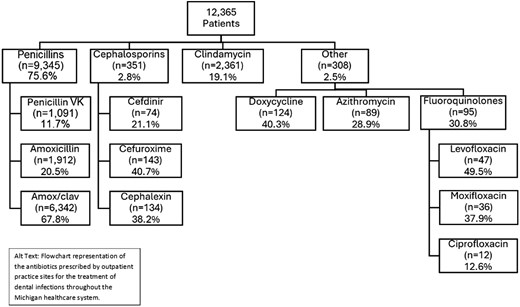
System-wide prescribing patterns for dental infections.
To compare patient outcomes between the treatment groups, a total of 1243 patients were screened for study inclusion, with 594 patients meeting inclusion criteria (amox/clav, n = 150; cephalosporins, n = 147; clindamycin, n = 150; other, n = 147) (Supplementary Figure 1). Patient baseline characteristics are described in Table 1. Patients were a median of 41 years old (interquartile range [IQR] 32–55) with a median body mass index of 29.5 kg/m2 (IQR 24.5–35.6) and Charlson Comorbidity Index of 0 (IQR 0–2). Among the full cohort, most patients were uninsured (37.5%); 27.1% had Medicaid, 26.6% had private insurance, and the remaining 8.8% had Medicare (P = .018). Intravenous antibiotics were given to 5.5% of patients prior to outpatient treatment with an oral antibiotic. Penicillin and cephalosporin allergies and intolerances are outlined in Table 1. There were 353 patients (59.4%) with a reported allergy or intolerance to a beta-lactam. Most patients in the cephalosporin (74.1%), clindamycin (72%), or other group (89.8%) had a reported allergy or intolerance to a beta-lactam. Of the 241 patients without a documented beta-lactam allergy or intolerance, 95 (39.4%) received an alternative to amox/clav, including 21.4% of patients receiving cephalosporins, clindamycin, or other antibiotics.
Baseline and Treatment Characteristics
| Amox-Clav (n = 150) | Cephalosporin (n = 147) | Clindamycin (n = 150) | Other (n = 147) | P Value | |
|---|---|---|---|---|---|
| Age (y), median (IQR) | 41 (31–59) | 40 (30–52) | 37.5 (30–46) | 46 (37–59) | <.001 |
| Female, n (%) | 73 (48.7) | 97 (66) | 83 (55.3) | 93 (63.3) | .010 |
| BMI (kg/m2), median (IQR) | 28.4 (23.8–34.3) | 29.7 (24.5–36.7) | 30.1 (24.2–37.1) | 29.8 (25.3–36.2) | .262 |
| CrCl (mL/min), median (IQR) | 108 (90–120) | 102 (83–120) | 112.5 (100–120) | 120 (98–120) | .001 |
| CCI index, median (IQR) | 1 (0–2) | 0 (0–1) | 0 (0–1) | 1 (0–2) | <.001 |
| Fever, n (%) | 0 | 1 (0.7) | 2 (1.3) | 0 | .302 |
| Leukocytosis (WBC >12 K/µL), n (%) | 4 (2.7) | 4 (2.7) | 2 (1.3) | 2 (1.4) | .714 |
| Diagnosis code, n (%) | |||||
| 149 (99.3) | 144 (96) | 150 (100) | 145 (96.7) | |
| 1 (0.7) | 3 (4) | 0 | 3 (3.3) | |
| 0 | 0 | 0 | 0 | .327 |
| 0 | 0 | 0 | 0 | |
| 0 | 0 | 0 | 0 | |
| Baseline imaging, n (%) | 18 (12) | 7 (4.8) | 2 (1.3) | 7 (4.8) | .001 |
| Abscess confirmed | 13 (72.2) | 2 (28.6) | 1 (50) | 3 (42.9) | .206 |
| Insurance status, n (%) | |||||
| Unsured | 68 (45.3) | 45 (30.6) | 48 (32) | 62 (42.2) | |
| Medicare/Medicaid | 51 (34) | 56 (38.1) | 59 (39.3) | 47 (32) | .018 |
| Private | 31 (20.7) | 46 (31.3) | 43 (28.7) | 38 (25.8) | |
| Prescribing entity, n (%) | |||||
| ED | 75 (50) | 66 (44.9) | 54 (36) | 41 (27.9) | |
| PCP | 14 (9.3) | 13 (8.8) | 6 (4) | 17 (11.6) | <.001 |
| Urgent care | 61 (40.7) | 68 (48.3) | 90 (60) | 89 (60.5) | |
| IV antibiotic given, n (%) | 5 (3.3) | 13 (8.8) | 9 (6) | 5 (3.4) | .166 |
| Metronidazole prescribed, n (%) | 0 | 65 (44.2) | 0 | 18 (12.2) | <.001 |
| Counseled to follow-up with dentist, n (%) | 121 (80.7) | 106 (72.1) | 137 (91.3) | 125 (85) | <.001 |
| Treatment duration (d), mean (±SD) | 8 (1.4) | 8 (1.7) | 8.4 (1.5) | 7.7 (2) | .003 |
| Penicillin allergy, n (%) | 2 (1.3) | 103 (68.7) | 101 (67.3) | 127 (86.4) | |
| Mild/moderate | 1 (50) | 61 (59.2) | 52 (51.5) | 30 (23.6) | |
| Severe | 1 (50) | 12 (11.7) | 15 (14.9) | 25 (19.7) | <.001 |
| Unknown | 0 | 30 (29.1) | 34 (33.7) | 72 (56.7) | |
| Penicillin intolerance, n (%) | 0 | 10 (6.8) | 6 (4) | 0 | <.001 |
| Cephalosporin allergy, n (%) | 2 (1.3) | 8 (3.4) | 15 (10) | 30 (20.4) | |
| Mild/moderate | 1 (50) | 8 (100) | 9 (60) | 6 (20) | <.001 |
| Severe | 0 | 0 | 1 (6.7) | 3 (10) | |
| Unknown | 1 (50) | 0 | 5 (33.3) | 21 (70) | |
| Cephalosporin intolerance, n (%) | 0 | 3 (2) | 0 | 1 (0.7) | .105 |
| Any beta-lactam reaction, n (%) | 4 (2.7) | 109 (74.1) | 108 (72) | 132 (89.8) | <.001 |
Abbreviations: CCI, Charlson Comorbidity Index; CrCl, creatinine clearance; ED, emergency department; IQR, interquartile range; PCP, primary care provider; SD, standard deviation; WBC, white blood cell.
Patients treated with clindamycin experienced the highest rate of treatment failure (11.3%), followed by cephalosporins (4.8%), amox/clav (2%), and other antibiotics (0.7%) (P < .001). Patients treated with clindamycin experienced significantly more treatment failure compared to all other cohorts (Table 2). There was no difference in treatment failure between any of the other cohorts. In a subgroup analysis of patients treated with cephalosporins, patients who received cefdinir had a significantly higher rate of treatment failure when compared to cefuroxime and cephalexin (14.8% vs 3.3% vs 1.7%, P = .023). There was no difference in treatment failure between patients treated with cefdinir and clindamycin (P = .534). Secondary outcomes are outlined in Table 3. There was no difference in median time to treatment failure between groups (P = .213). Adverse events were reported in 8 patients, including 4 patients who received cephalosporins and 4 who received clindamycin; 1 patient reporting a cephalosporin ADE and 1 patient reporting a clindamycin ADE required a change of therapy due to an intolerable reaction. No patient in any group experienced C. difficile within 30 days of treatment.
Treatment Failure Within 30 Days
| Amox/Clav n = 150 | Cephalosporins n = 147 | Clindamycin n = 150 | Other n = 147 | P Value (Amox/Clav vs Cephalosporins) | P Value (Amox/Clav vs Clindamycin) | P Value (Amox/Clav vs Other) | P Value (Cephalosporins vs Clindamycin) | P Value (Cephalosporins vs Other) | P Value (Clindamycin vs Other) | |
|---|---|---|---|---|---|---|---|---|---|---|
| Treatment Failure, n (%) | 3 (2) | 7 (4.8) | 17 (11.3) | 1 (0.7) | .215 | .001 | .623 | .038 | .067 | <.001 |
Retreatment Characteristics Following Failure
| Amox-Clav (n = 3) | Cephalosporins (n = 7) | Clindamycin (n = 17) | Other (n = 1) | P Value | |
|---|---|---|---|---|---|
| Retreatment site, n (%) | .217 | ||||
| ED | 2 (66.7) | 5 (71.4) | 8 (47.1) | 0 | |
| PCP | 0 | 0 | 3 (17.6) | 1 (100) | |
| Urgent care | 1 (33.3) | 2 (28.6) | 6 (35.3) | 0 | |
| Time to treatment failure (d), median (IQR) | 22 (16–23) | 5 (3–17) | 12 (4.5–17) | 22 (22–22) | .213 |
| Adverse drug reactions, n (%) | 0 | 4 (2.7) | 4 (2.7) | 0 | .044 |
| Nausea/vomiting | 0 | 1 (25) | 2 (50) | 0 | |
| Yeast infection | 0 | 2 (50) | 1 (25) | 0 | |
| Other | 0 | 1 (25) | 1 (25) | 0 | |
| Change due to side effects, n (%) | 0 | 1 (0.7) | 1 (0.7) | 0 | .571 |
| New antibiotic prescribed, n (%) | .512 | ||||
| Amox-clav | 2 (66.7) | 2 (28.6) | 3 (17.6) | 0 | |
| Cephalosporins | 1 (33.3) | 0 | 2 (11.8) | 0 | |
| Clindamycin | 0 | 3 (42.8) | 8 (47.1) | 1 (100) | |
| Other | 0 | 2 (28.6) | 2 (23.5) | 0 |
Abbreviations: ED, emergency department; IQR, interquartile range; PCP, primary care provider.
Retreatment characteristics of the 28 patients who experienced treatment failure are outlined in Table 3. Most patients were retreated at the ED (53.6%), followed by urgent care (32.1%) and primary care (14.3%) (P = .217). Clindamycin was the agent most likely to be prescribed for retreatment (42.9%) followed by amox/clav (25%) and other antibiotics (21.4%). All patients who experienced failure with amox/clav were retreated with a beta-lactam; 29.4% of patients who experienced treatment failure with clindamycin were retreated with a beta-lactam, and 28.6% of patients experiencing failure with a cephalosporin were retreated with amox/clav.
Variables eligible for inclusion in the multivariate logistic regression model are outlined in Table 4. Treatment with clindamycin (odds ratio [OR] 6.2 [95% confidence interval (CI) 2.5–15.81]) or cefdinir (OR 9.9 [95% CI 2.67–36.97]) was independently associated with treatment failure.
Treatment Failure Regression
| Odds Ratio | 95% Confidence Interval | P Value | |
|---|---|---|---|
| Clindamycin | 6.2 | (2.50–15.81) | <.001 |
| Cefdinir | 9.9 | (2.67–36.97) | .001 |
| BMI >30 | 1.2 | (.52–2.59) | .718 |
| Age <40 y | 1.7 | (.73–3.87) | .218 |
| Any beta-lactam reaction | 1.3 | (.54–3.18) | .539 |
| Medicaid | 1.7 | (.77–3.94) | .184 |
Abbreviation: BMI, body mass index.
DISCUSSION
Our findings provide insight into current prescribing practices for suspected dental infections from a large sample of primary care, ED, and urgent care practitioners. Few studies have previously evaluated prescribing trends for dental infections in outpatient settings outside of dental offices or the ED. Consistent with ADA guideline recommendations, we observed that penicillins were the most commonly prescribed antibiotic class; however, amox-clav was prescribed significantly more than penicillin VK or amoxicillin. This is in contrast to ADA recommendations and previous studies demonstrating that dentists most often prescribe amoxicillin or penicillin for suspected infections. A population-level analysis by Thompson et al [5] evaluating international prescribing practices by dentists demonstrated that amoxicillin (61.9%) was most commonly prescribed, with amox-clav making up 3% of prescriptions. In 2018, Durkin et al [14] published similar findings following evaluation of a large insurance claims database and found that amoxicillin (57%) and penicillin (12%) were most commonly prescribed by dentists in the United States; they also observed that amox/clav made up only 3% of total prescriptions [15]. We hypothesize that in our cohort, nondentist prescribers were more comfortable prescribing amox/clav due to lack of dental intervention for source control and desiring broader coverage for suspected polymicrobial infection or abscess [16]. While the ADA recommends prompt intervention in cases of dental pain and swelling in an effort to avoid prescribing antibiotics, that is not always possible. In our cohort, most patients were uninsured or had government-funded insurance. In the United States, the incidence of patients presenting to the ED for nontraumatic dental conditions has been increasing since 2020 [17]. Lack of comprehensive dental insurance likely contributes to the number of patients seeking care for nontraumatic dental conditions outside of dental offices.
Clindamycin was the second most prescribed agent in our cohort, and treatment failure was highest in patients who received clindamycin. Several studies demonstrate an increase in clinical failure with clindamycin compared to penicillin-based therapies for the treatment of dental infection as well as for surgical infection prophylaxis associated with dental surgery [18, 19]. A retrospective cohort study by Mahmoud et al [10] compared IV amox/clav vs IV clindamycin for the treatment of hospitalized patients with odontogenic infections. Treatment failure was significantly more likely in patients who received clindamycin compared to amox/clav (14% vs 2.2%) and clindamycin was associated with a 7-fold increase in risk of treatment failure [10]. These findings are similar to our own demonstrating a 6-fold increase in treatment failure within 30 days when clindamycin was prescribed over other antibiotic classes. Mahmoud et al [10] also saw significantly more organisms resistant to clindamycin in the clindamycin-treated group (P = .015). Notably, all patients who were treated with clindamycin had a reported penicillin allergy. Chadha et al [19] similarly evaluated resistance rates of odontogenic infections in patients with reported penicillin allergies. They found that patients with a penicillin allergy were at significantly higher risk for resistance (relative risk [RR] 2.34 [95% CI 1.66–3.32], P < .001), which was driven by clindamycin resistance (RR 3.17 [95% CI 1.93–5.18], P < .001). We surprisingly observed that 39.4% of patients in our study without a beta-lactam allergy or intolerance received an alternative to amox/clav. This included 28% of patients in the clindamycin group. Despite previous literature demonstrating increased risk of treatment failure and antimicrobial resistance, clindamycin was the most commonly prescribed agent for retreatment after failure of initial therapy in our cohort. A recent systematic review evaluating antimicrobial resistance in odontogenic infections found that most regions globally report higher rates of resistance to clindamycin than alternative agents, such as penicillins and cephalosporins for, commonly isolated oral flora [16]. The authors stressed that beta-lactam agents should be prioritized for the treatment of dental infections, with clindamycin only considered in the case of severe allergy after thorough investigation into allergy history.
Our findings highlight important implications for antimicrobial stewardship education regarding the optimal treatment of dental infections in patients with reported beta-lactam allergy or intolerance. Specifically, reported allergy or intolerance should be clarified with patients or caregivers prior to excluding prescribing of all beta-lactams. Approximately 10% of the US population has a reported penicillin allergy, although clinically significant IgE-mediated or T lymphocyte–mediated penicillin hypersensitivity is significantly less common (<1%) [20]. Patients with reported penicillin allergies are more likely to receive less effective therapy, which can lead to increased hospital lengths of stay, treatment failure, and adverse events [20–22]. Multiple studies demonstrate that cross-reactivity between beta-lactam agents is low and most patients with penicillin allergies can safely receive cephalosporins. A retrospective, observational study by Banerjee et al [12] compared oral amox/clav to oral cephalexin/clavulanate or cefuroxime for the treatment of outpatient dental infections. The authors observed no difference in clinical improvement at day 10 across groups (96.8% vs 98.3 vs 98.9, P = .446). We similarly observed no difference in treatment failure between patients treated with cephalosporins and amox/clav. In subgroup analysis, patients treated with cefdinir, an oral third-generation cephalosporin, experienced significantly higher rates of treatment failure compared to patients receiving cefuroxime or cephalexin. Patients treated with cefdinir were nearly 10 times more likely to experience treatment failure within 30 days compared to alternative agents. We hypothesize that this may be due to cefdinir's unfavorable pharmacokinetic properties including low bioavailability and high protein binding, which could limit drug penetration at the site of odontogenic infections [23]. While our findings overall support the use of cephalosporins as a safe and effective alternative to penicillins for treating suspected dental infections, caution should be used when selecting a cephalosporin agent, and the use of cefdinir should be avoided. Despite the 2019 ADA guidelines’ emphasis on cephalexin as the first-line alternative to penicillins in patients with mild-to-moderate penicillin allergies, cephalosporins made up only 2.8% of prescribing in our entire health system, which was far less than clindamycin.
A total of 35.3% of patients treated with clindamycin and 7.5% of patients treated with other antibiotics reported only a mild or moderate reaction to beta-lactams and were likely able to safely receive an alternative beta-lactam agent. Notably, 27.4% of the total population had an “unknown” allergy listed to either penicillins or cephalosporins where no reaction was documented; 81% of these patients received an alternative therapy to beta-lactams demonstrating the need for readily accessible allergy assessment tools to improve provider comfort with clarifying allergies to increase the use of first-line beta-lactam agents. The PEN-FAST score is a validated tool using 4 simple questions to identify low-risk penicillin allergies, which may be appropriate for oral challenge. While there are no currently published studies evaluating the use of this tool to optimize agent selection in dental infections, multiple previous publications demonstrate its benefit in optimizing the use of beta-lactams in other disease states [24, 25]. When feasible, operationalizing use of the PEN-FAST tool in primary care, ED, and urgent care settings may help optimize therapy and improve patient outcomes in dental infections.
This study contains limitations that must be considered. First, this was a retrospective evaluation that is limited to the accuracy of documentation available in the medical record. Although our EMR does communicate with other health systems, it is possible that patients could have followed up outside of this network and treatment failure was underestimated. The study period did overlap the coronavirus disease 209 pandemic, which could have limited patient access to dental care; however, we would have expected patients across all treatment groups to be impacted similarly. Not all patients presenting with tooth pain or swelling require antibiotic therapy; therefore, the diagnosis of dental infection may have been overcalled in some patients. Dental records were also not accessible to confirm if patients received definitive treatment or intervention by a dentist. The cephalosporin and other groups contained multiple antibiotic agents; while the larger group may have been adequately powered, drawing strong conclusions from sub-groups is difficult. The lowest incidence of failure was seen within the other group; however, this was a heterogenous group of antibiotics, each with a small group of patients which by themselves were not powered and risk drawing a type II error. This group of antibiotics may represent a promising alternative to clindamycin for the treatment of dental infections in patients with severe beta-lactam allergy; however, more research is needed evaluating the outcomes of these agents with a larger sample size.
CONCLUSIONS
Outpatient prescribing for dental infections across a health system revealed an overall preference for first-line penicillins and opportunity to improve the use of penicillins in patients with and without beta-lactam allergy or intolerance. Clindamycin and cefdinir were independently associated with treatment failure; alternative agents should be prioritized over clindamycin and cefdinir in patients unable to receive penicillins.
Supplementary Data
Supplementary materials are available at Open Forum Infectious Diseases online. Consisting of data provided by the authors to benefit the reader, the posted materials are not copyedited and are the sole responsibility of the authors, so questions or comments should be addressed to the corresponding author.
Notes
Author contributions. L. T. H., K. M. E., K. J. E., D. M. H., and L. E. D. participated in study conception, design, data analysis and synthesis, and manuscript preparation and editing. A. P. J., J. J. B., F. A., K. J. B., and R. N. I. participated in study design, data synthesis, and manuscript editing.
Financial support. None declared.
Data availability. The data underlying this article are available in the article and in its online supplementary data.
References
Author notes
Potential conflicts of interest. All authors: No reported conflicts.


Comments