


 https://orcid.org/0000-0001-8126-5868

Abstract
Since 2023, Europe has implemented infant respiratory syncytial virus prevention programs. Based on real-world data (2022–2025) from 5 Spanish and 19 UK hospitals, hospitalizations for respiratory syncytial virus–lower respiratory tract infection declined by 55% in Spain (77% in 0–6 months) and 18% in the United Kingdom (31% in 0–6 months), with patterns confirmed by interrupted time series analysis.
BACKGROUND
Respiratory syncytial virus (RSV) is a leading cause of pediatric hospitalization for respiratory tract infections during the winter season in nontropical regions. Besides the hospital burden, hospitalized infants have a higher risk for systemic complications later in life. Long-acting monoclonal antibodies (nirsevimab, 2023; clesrovimab, 2025) and a maternal vaccine (RSVPreF) have been deployed for infant RSV prevention [1].
Spain implemented universal long-acting monoclonal antibody prophylaxis in September 2023, while the United Kingdom introduced maternal RSV vaccination in September 2024. We conducted an ecological analysis across 3 RSV seasons (June 2022–May 2025) using administrative hospital data from preselected sites in Spain and the United Kingdom to evaluate population-level changes in RSV-related infant hospitalizations.
METHODS
We conducted a multicountry, multicenter ecological cohort study based on an observational retrospective design, using anonymized datasets from hospital electronic health care records. To enable comparison between pre- and postimplementation periods for nirsevimab in Spain and maternal RSV vaccination in the United Kingdom, we acquired data from 3 consecutive seasons from 1 June 2022 to 31 May 2025. Sites of varying sizes were included from the commercial LOGEX RTI Observatory dataset, comprising 5 hospitals in Spain (Madrid, Basque Country, and Valencia) and 19 in the United Kingdom across 6 geographic regions.
Spain introduced nirsevimab prophylaxis for all infants in September 2023. Due to regional regulations, the Basque Autonomous Community initially limited use to high-risk infants <3 months of age at 1 study site. The United Kingdom started a maternal RSV vaccination program nationwide in September 2024.
Infants and toddlers aged 0 to 24 months hospitalized with a diagnosis of lower respiratory tract infection (LRTI; J09–J18, J20–J22, J40, J44.0) were included in the study. RSV-LRTI hospital admissions were identified by RSV-specific ICD-10 codes (J12.1, J20.5, J21.0, B97.4) as primary or secondary diagnosis. For a subset of sites (5 in United Kingdom and all Spanish sites), laboratory testing data for RSV were used to validate ICD-10 coding accuracy (agreement: United Kingdom, 96%; Spain, 94%).
The primary analysis reported absolute numbers of RSV-LRTI hospital admissions stratified by country, age group (0–6, 7–12, 0–12, 13–24 months), and season (defined annually as 1 June–31 May). To evaluate the impact of RSV prevention programs, we performed a controlled interrupted time series analysis using non-RSV LRTI as the control group, defined as all LRTI inclusion codes except the RSV-LRTI specific codes. This approach enabled estimation of what RSV hospitalization trends would have been in the absence of prophylaxis programs (the counterfactual scenario) by comparing observed RSV trends against the control group trajectory. Given the overdispersion in hospitalization counts, we utilized a negative binomial regression model and accounted for seasonality and secular trends. In the UK dataset, the time series starts at September rather than June to correct for an unusual summer peak in RSV admissions, which would otherwise bias the negative binomial model. All analyses were conducted in R version 4.3.2.
Ethical Statement
For Spain, the Research Ethics Committee on Medicines of the Gregorio Maranon University General Hospital provided a favorable opinion for conducting the research, submitted under issue VEO000619. For the United Kingdom, ethical review was not required as data were obtained through routine care using deidentified data.
RESULTS
Overall Hospitalization Trends
Spain
Following implementation of the nirsevimab program in September 2023, RSV-LRTI hospital admissions decreased substantially from 886 in 2022–2023 to 398 in 2024–2025, a 55% reduction (Table 1). Largest reductions occurred in the youngest infants. RSV-LRTI hospitalizations decreased by 77% among infants aged 0 to 6 months (550 to 129), 33% among infants aged 7 to 12 months (165 to 110), and 67% in the combined 0- to 12-month age group (715 to 239). Hospitalizations among older infants (13–24 months) remained relatively stable (171 to 159).
RSV-LRTI Hospital Admissions by Country, Age Group, and Season
| Country: Age Group, mo | 2022–2023 | 2023–2024 | 2024–2025 | Change: 2022–2023 to 2024–2025, % |
|---|---|---|---|---|
| Spain | ||||
| 0–6 | 550 | 190 | 129 | −77 |
| 7–12 | 165 | 118 | 110 | −33 |
| 0–12 | 715 | 308 | 239 | −67 |
| 13–24 | 171 | 147 | 159 | −7 |
| Total: 0–24 | 886 | 455 | 398 | −55 |
| UK | ||||
| 0–6 | 2960 | 2451 | 2054 | −31 |
| 7–12 | 749 | 670 | 704 | −6 |
| 0–12 | 3709 | 3121 | 2758 | −26 |
| 13–24 | 739 | 737 | 871 | +18 |
| Total: 0–24 | 4448 | 3858 | 3629 | −18 |
Abbreviations: LRTI, lower respiratory tract infection; RSV, respiratory syncytial virus.
United Kingdom
RSV-LRTI hospitalizations decreased by 18% from 4448 in 2022–2023 to 3629 in 2024–2025. RSV-LRTI hospitalizations decreased by 31% (2960 to 2054) in infants aged 0 to 6 months, and by 6% among infants aged 7 to 12 months (749 to 704), and 26% in the combined 0- to 12-month age group (3709 to 2758; Table 1). In contrast to Spain, hospitalizations among older infants (13–24 months) increased by 18% (739 to 871).
Results of Controlled Interrupted Time Series Analysis
The controlled interrupted time series analysis (Figure 1) demonstrated statistically significant reductions in RSV hospitalizations in Spain postintervention with respect to controls across all age categories (Supplementary Table 1). Relative to the control series, RSV hospitalizations decreased by 54% in the 0- to 24-month age group (effect ratio [ER], 0.46; 95% CI, .35–.60), with a 67% reduction in patients aged 0 to 6 months (ER, 0.33; 95% CI, .26–.43) and 31% reduction in patients aged 7 to 12 months (ER, 0.69; 95% CI, .49–.99). A sensitivity analysis excluding the single Spanish site that initially implemented nirsevimab in only high-risk infants yielded similar results relative to the control series: RSV hospitalizations decreased by 57% in infants aged 0 to 24 months (ER, 0.43; 95% CI, .33–.56), with a 72% reduction in patients aged 0 to 6 months and 36% reduction in patients aged 7 to 12 months (ER, 0.64; 95% CI, .45–.91; Supplementary Table 2).
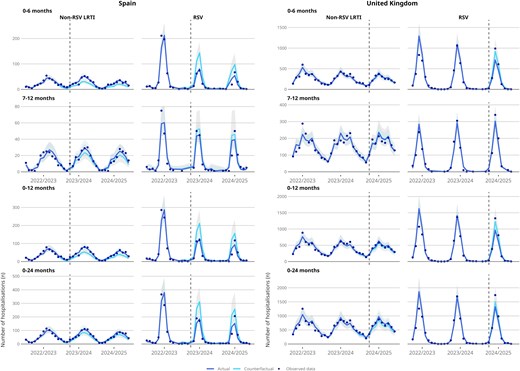
Monthly RSV-LRTI hospital admissions, CITS model predictions, and counterfactual for Spain and United Kingdom. Dark blue dots represent the monthly observed number of hospitalizations. The dark blue line represents predicted hospitalizations from the CITS model, which is fitted to the observed monthly counts. Gray shading shows the 95% CIs. The light blue line shows the counterfactual scenario, estimating what hospitalizations would have looked like without the immunization program. The vertical dashed line marks the start of the RSV immunization program. Observed admissions follow model predictions, with a marked decline after program introduction, particularly in Spain. A counterfactual trend indicates higher expected hospitalizations in the absence of immunization. CITS, controlled interrupted time series; LRTI, lower respiratory tract infection; RSV, respiratory syncytial virus.
In the United Kingdom, significant reductions relative to control series were observed in 0–6 months (−27%, ER, 0.73; 95% CI, .58–.91), 0–12 months (−29%, ER, 0.71; 95% CI, .57–.90), and overall 0–24 months (−23%, ER, 0.77; 95% CI, .61–.97), with no significant effect in 7–12 months (+1.5%, ER, 1.01; 95% CI, .81–1.28).
DISCUSSION
This multicountry ecological study provides some of the first comparative evidence on the population-level impact of 2 RSV prevention strategies. Following implementation of the Spanish nirsevimab program, we observed substantial and statistically significant reductions in RSV-LRTI hospitalizations across all pediatric age groups, with greatest impact in infants aged 0 to 6 months. In the United Kingdom, we observed a more modest reduction following maternal vaccination implementation, with statistically significant decreases in all age groups except for 7–12 months. Our results align with existing data from other geographies. Studies from Luxembourg and Chile, which implemented universal nirsevimab prophylaxis, showed reductions in RSV-LRTI hospitalizations of 69% and 77%, respectively, in the eligible population, and preliminary data from a study in Argentina, which implemented maternal vaccination, showed 32% reduction in infants <3 months old [2–4]. Recent evidence from France suggests that nirsevimab may be more effective in preventing RSV-related hospitalizations than maternal vaccination [5]. Additionally, a recent multicountry analysis in Spain, Italy, and the United Kingdom reported mixed findings across countries with different immunization programs [6].
The greater estimated impact for nirsevimab over maternal vaccination in our study may reflect several factors. First, nirsevimab can be administered in alignment with the RSV season, providing entire season protection. In contrast, the duration of infant protection from maternal vaccination depends on the timing of immunization during pregnancy, which may not align with the RSV season. Second, program implementation timing and coverage rates differ among countries. Whereas Spain exhibited high uptake and acceptance of the program, with published estimates indicating that nirsevimab coverage exceeded 80% in most parts of Spain during the study period [7–9], maternal vaccination coverage in the United Kingdom ranged from 40.5% in September 2024 to 54.7% through March 2025 [10].
Our study has several limitations. First, the limited number of preprophylaxis seasons limits pre- and post comparisons. Second, differences may have influenced results in terms of number of sites among countries, testing practices, hospital catchment areas, admission policies, and local implementation timing. Third, we relied on ICD-10 coding to identify RSV and non-RSV cases, although validation analysis showed high concordance with laboratory testing. Fourth, the UK program started in September 2024, meaning that some infants hospitalized early in the 2024–2025 season were born to mothers who had not yet had the opportunity to receive the RSV vaccine, with regional rollout timing contributing to variability. This may underestimate the full potential impact of maternal immunization. Last, 1 Spanish site initially implemented nirsevimab targeting only high-risk infants, potentially diluting the observed effect. However, a sensitivity analysis excluding this site was consistent with the primary analysis.
Despite these limitations, our findings provide valuable early evidence on the population-level impact of different RSV prevention strategies, representing a public health impact measure reflected in reductions in RSV-related hospitalizations. The substantial reductions observed, particularly in Spain, suggest that broad infant RSV immunization programs can significantly reduce RSV hospitalizations. Continued longitudinal surveillance across multiple seasons will be important to fully understand the long-term impact of these prevention strategies. The study continues through the 2025–2026 RSV season.
Supplementary Data
Supplementary materials are available at Open Forum Infectious Diseases online. Consisting of data provided by the authors to benefit the reader, the posted materials are not copyedited and are the sole responsibility of the authors, so questions or comments should be addressed to the corresponding author.
Notes
Acknowledgments. We express our gratitude to the hospitals in Spain and the United Kingdom for the collaboration in this research. S. N. F. is an NIHR senior investigator. The RTI Observatory Investigators: Spain—Luis Puente Maestu and Ana Maria Angulo Chacón, Hospital Gregorio Marañón, Madrid; Igor Iturbe Susilla, Basurto University Hospital, Bizkaia; Noelia García Barrio, Hospital Universitario 12 Octubre, Madrid; Laura del Pino Rodríguez Suarez, Hospital Universitario Severo Ochoa, Madrid; Francisco Sanz Herrero, Consorci Hospital General Universitari de València. United Kingdom—Andy Ritchings, Mid Cheshire, Crewe; Oana Anton, East Sussex NHS Trust and Brighton and Sussex Medical School, Eastbourne.
Data availability. Data not publicly available.
Financial support. This work was supported by Sanofi Pasteur and AstraZeneca.
References
Author notes
Potential conflict of interest. O. M., K. M., and R. K. are employees of and may own shares/stock options in Sanofi. S. A. M. is a consultant to P95, who received Sanofi funding via LOGEX to conduct this study. R. S. L., E. D., and J. J. D. are employees of LOGEX, who received funding from Sanofi to conduct this study. S. N. F. received grants or contracts from Pfizer, Sanofi, GSK, Johnson & Johnson, Merck, AstraZeneca, Valneva, Moderna, and BioNTech as a clinical trial investigator on behalf of the institution; received honoraria for symposium participation paid to the institution from Moderna, Pfizer, Sanofi, and Novavax; received honoraria for advisory boards participation paid to the institution from AstraZeneca, MedImmune, Sanofi, Pfizer, Seqirus, Merck, Johnson & Johnson, and MSD. The RTI Observatory Investigators: FSH received honoraria for symposium participation from MSD, GSK and Pfizer. All other authors: No reported conflicts.


Comments