


 https://orcid.org/0009-0003-6145-2561

Abstract
This study examines the impact of a military coup on citizens’ democratic attitudes in neighboring countries. Previous studies have examined the domestic consequences of coups and the possibility of coup contagion across countries, yet little is known about how citizens in neighboring countries respond to coups, despite the potential implications of public opinion for incentives surrounding future coup attempts. Using a nationally representative survey from multiple countries and the unexpected event during survey design, we demonstrate that individuals exposed to news of the coup express greater support for democracy and elections and greater rejection of authoritarian rule, suggesting that citizens view the coup as a cause of political instability rather than a means of liberalization. The effect size is comparable across countries and respondent characteristics, while TV and radio owners react more quickly. These results cannot be explained by media bias, institutional trust, citizens’ learning about the poor performance of military regimes, or concern about their future economic instability. Given the high costs of coup attempts under strong popular opposition, stronger public support for democracy may reduce incentives for coups in neighboring countries. These findings also provide one possible micro-level explanation for the limited empirical support for the coup contagion hypothesis.
Military coups are a significant cause of political instability. They deprive citizens’ opportunity for political participation, and in many cases, post-coup military regimes gradually become dictatorships, hindering democratization. Consequently, coups are often internationally condemned and lead to aid suspensions, economic sanctions, and isolation from the global community. However, they remain prevalent particularly in developing countries.
Previous studies demonstrate the negative political and economic consequences of coups for both the affected country and its citizens (Bell, 2016; Bleck & Michelitch, 2017; Grier et al., 2024; Lachapelle, 2020; Thyne & Powell, 2016), while other studies highlight the spillover effects on neighboring countries (Ades & Chua, 1997; Sakstrup, 2021). In particular, scholars have long argued the coup contagion: i.e., diffusion of coups to other countries (Caruso et al., 2020; Li & Thompson, 1975; Miller et al., 2018; Saine, 2008; Singh, 2022). Although insightful, how people in neighboring countries respond to a coup has been scarcely explored in the literature. Since coups that change national leaders without elections are a severe violation of democracy, coups in neighboring countries can affect citizens’ democratic attitude.
Citizens' reaction in neighboring countries is relevant to understanding the theoretical validity of the coup contagion and, more broadly, the diffusion of institutional regimes. Li and Thompson (1975) assume that contagion occurs because coup organizers learn about optimal actions and the cost of a coup from cases in other countries. Studies on the diffusion of regimes argue that it occurs because countries are rewarded when their regimes are similar to those of their neighbors (Brinks & Coppedge, 2006; Cederman & Gleditsch, 2004). However, the role of public opinion has not been elaborated in the literature. This is crucial because citizens' negative reactions to coups and military regimes may reduce incentive for militaries in neighboring countries to stage a coup for two reasons (Casper & Tyson, 2014; Thyne et al., 2017). First, coups without popular support can be prevented or defeated by civil resistance (Esen & Gumuscu, 2017; Roberts, 1975). Second, even if successful, international pressure, such as aid suspensions, influences the persistence of the post-coup regime; therefore, coup organizers must portray their actions as supported by citizens (Grewal & Kureshi, 2019; Marinov & Goemans, 2014; Yukawa et al., 2022). Hence, coup attempts without popular support are too costly. Studying the reaction of citizens in neighboring countries, therefore, enables us to elaborate on the theoretical foundation of the coup contagion hypothesis.
This study bridges this gap by examining the impact of exposure to information about the 2008 Guinean coup on citizens' democratic attitudes in two neighboring countries: Liberia and Mali. To the best of our knowledge, this is the first study to examine the impact of a coup on political attitude in neighboring countries. The coup took place on December 23rd in 2008, just 5 hr following the death of Lansana Conté, then-president, from health complications. As is common with post-Cold War coups (Marinov & Goemans, 2014; Yukawa et al., 2022), the leader stated that he had organized the coup to prevent political stagnation and pledged to hold a presidential election. Guinean citizens initially reacted optimistically to the coup, while the international responses were condemnatory. The mass media in neighboring countries reported both pieces of information neutrally.
Theoretically, exposure to news of a coup in a neighboring country can affect citizens' political attitudes through social learning and by raising beliefs about coup contagion (Cho, 2014; Finseraas & Listhaug, 2013; Metcalfe et al., 2011). These channels are plausible, considering the salience of coups in West Africa and their spatiotemporal correlation of occurrence (Caruso et al., 2020; Li & Thompson, 1975; Miller et al., 2018; Saine, 2008). However, whether it affects democratic attitudes positively or negatively is an empirical question, given the multifaceted concepts of democracy and two opposing aspects of the coup; it was an undemocratic regime change, but it removed a dictator. Therefore, these aspects affect the attitudes toward each democratic concept differently. Specifically, those exposed to condemnatory media reports may reaffirm the importance of democracy, supporting democracy and elections and rejecting military rule more strongly. By contrast, news of optimistic Guinean reactions may raise citizens' perceptions of the authoritarian regime's efficacy and diminish their perceptions of democracy and elections. Finally, coup actors often claim that a coup is the only means of achieving political liberalization: a democratic coup (Derpanopoulos et al., 2016; Varol, 2017). Therefore, while citizens exposed to such claims may reaffirm the importance of democracy, they may also become more accepting of unconstitutional regime change and military-led interim government, thereby weakening support for elections.
To answer this question, this study exploits a quasi-experimental setting in which the Guinean coup occurred during the Afrobarometer survey period in Mali and Liberia, allowing us to use the Unexpected Event during Survey Design methodology. Specifically, we restrict the sample to the respondents interviewed within 9 days before and after the coup. Given the plausibly exogenous timing of the coup and survey interviews, we estimate changes in respondents' attitudes toward democracy between those interviewed just before and after the coup. The respondent characteristics are balanced between the groups, except that the latter group was exposed to information about the coup, enabling us to identify the immediate impact of exposure. We use two types of measures for democratic attitudes: attitudes to individual democratic concepts, such as support for elections and freedoms, and their composite index which captures the overall democratic attitudes.
Analyzing the impact of a coup on citizens in other countries also has methodological advantages. Identifying the causal impact of a coup on domestic citizens is challenging, given the endogenous nature of coup timing and the difficulty of obtaining honest opinions from representative respondents during a coup. Additionally, public opinion within the affected country is likely influenced by media capture by the coup actor, as well as by increased political and economic uncertainty (Enikolopov & Petrova, 2015). In contrast, in neighboring countries, public opinion is less likely to be influenced by the media capture or fear of military retaliation. Furthermore, the timing of the coup is exogenous, and representative data are available.
The results show that respondents interviewed after the coup exhibit greater support for democracy. The effect size is comparable between countries and across respondents' language, access to mass media, geographical proximity to Guinea, and political participation, while TV and radio owners respond to the coup more quickly.
Our conceptual framework suggests that these positive impacts occur when citizens recognize the coup as a cause of political instability or a tool of political liberalization (i.e., democratic coup). It is important to identify these mechanisms because they predict the opposite implications for the coup incentive in neighboring countries. Therefore, we also examine the impact on each measure of democratic attitudes. The results show that greater support for democracy is attributed to the increase in support for elections and rejection of military rule, one-man rule, and one-party rule, suggesting that the coup is seen as a cause of political instability. We also show that these results cannot be explained by respondents' concern about future economic instability, learning about the poor performance of military regimes, high institutional trust in regional organizations, or media bias. Finally, we discuss the plausibility of assumptions for these attitudinal changes to indeed influence potential coup plotters' incentives for a coup attempt and provide suggestive supporting evidence.
We believe that our results are generalizable for three reasons. First, West Africa is one of the most coup-prone regions in Africa (McGowan, 2003), and key characteristics—such as the level of democracy, military expenditure, and citizens' political attitudes and behaviors—are comparable between our study countries and other West African countries. Second, despite considerable socioeconomic and ethno-linguistic differences between Mali and Liberia, we observe consistent impacts across countries and respondent characteristics. Third, theoretically, the impact of a coup on democratic attitudes can be either positive or negative, depending on factors such as the incumbent president's dictatorship and the possibility that the coup actor will become a dictator (Grewal & Kureshi, 2019; Lachapelle, 2020). In this context, the Guinean coup had the potential to gain support in neighboring countries, given the dictatorial president and the media reports of Guinean citizens' positive reactions. In addition, the coup was bloodless, and the coup actor promised to hold a presidential election within 2 years. Nonetheless, we find robust negative impacts on authoritarian regimes and positive impacts on democracy, suggesting that our results are a conservative estimate of the impact of coups in general.
These findings contribute to the literature on the diffusion of democratic and authoritarian regimes across countries. Previous studies argue the coup contagion hypothesis, and this idea is widely believed by political leaders (Miller et al., 2018). However, there is no empirical consensus on its validity. Although some studies suggest the possibility of contagion (Li & Thompson, 1975; Saine, 2008), Miller et al. (2018) argue that the key assumptions underlying this hypothesis do not apply to coups and that previous empirical studies suffer from identification issues, such as common shocks. Using a spatial dependence model, they find insignificant impacts. Furthermore, Lehoucq and Pérez-Liñán (2014) show that the occurrence of a coup is negatively associated with the coup prevalence in neighboring countries. Therefore, existing evidence remains mixed at best, particularly because the mechanisms driving insignificant or negative spillover effects are not well understood (Miller et al., 2018). Our findings provide one possible micro-level explanation for this. The probability of a coup's success and the survival of the post-coup regime likely increase with citizens' support for the coup actor (Casper & Tyson, 2014; Esen & Gumuscu, 2017; Roberts, 1975; Thyne et al., 2017). However, our findings suggest that the occurrence of a coup in a neighboring country strengthens citizens' democratic attitudes, thereby potentially reducing incentives for coup attempts. Whether the attitudinal changes actually mitigate coup contagion, however, depends on the factors such as the persistence of these changes and the extent to which public opinion is observable to the military.
This study also contributes to the literature on the formation of public opinion. Previous studies have demonstrated the impact on individuals' political attitudes of negative shocks that occurred in their and other countries, such as terrorism (Akay et al., 2020; Amarasinghe, 2023; Finseraas & Listhaug, 2013; Malásquez & Salgado, 2023; Metcalfe et al., 2011; Rehman & Vanin, 2017; Schüller, 2016), corruption (Ares & Hernández, 2017), crime (Blanco & Ruiz, 2013), natural disaster (Goebel et al., 2015), and conflict (Adhvaryu & Fenske, 2023). For example, Rehman and Vanin (2017) find that terrorist attacks reduce support for democracy in Pakistan, while Malásquez and Salgado (2023) show that exposure to conflicts negatively affects political beliefs regarding the importance and works of democracy. This study contributes to this literature by examining the impact of a political shock directly related to democratic violation and finding that it rather reinforces the democratic attitude.
Context
The 2008 Guinean coup
The coup in Guinea occurred on December 23, 2008, triggered by the death of former President Lansana Conté. His death was announced at approximately 2 a.m. on December 23 by Aboubacar Somparé, the speaker of the national assembly. While the official cause of death remains unknown, Conté had long suffered from health issues, particularly diabetes. Just 5 hours later, at around 7 a.m., a military group, led by Captain Moussa Dadis Camara, announced via state radio and television that they had seized power and established a new governing body, the National Council for Democracy and Development (CNDD). Following the announcement, Prime Minister Ahmed Tidian Suare initially denied the suspension of the constitution and dissolution of the government as announced by CNDD. Diarra Camara, the Military chief of staff, also emphasized that the coup was just an attempt, not complete. Furthermore, without the coup, a presidential election was expected to be held within 60 days of Lansana Conté's death, and Aboubacar Sompare was to serve as interim leader until then. However, after internal negotiations, the Congressional Research Service reported that Dadis Camara was officially approved as Guinea's president on December 24 (Arieff & Cook, 2009).
On December 25, Dadis Camara stated in an interview that the coup was necessary to prevent political stagnation and to block the transfer of power to Diarra Camara, with whom he had strained relations (Jeune Afrique, 2009). He also accused the former Conté's corruption. Importantly, he pledged to hold presidential elections within 2 years and assured the public that he would not run for office himself.
However, concerns regarding the CNDD government persisted. First, even without the coup, presidential elections had already been scheduled for May 2009. Although the coup was bloodless, power was seized by force rather than through constitutional means. Second, the new government was heavily dominated by military personnel—9 out of 29 members were from the military, occupying key positions such as defense, finance, and justice (Souaré, 2009).
Indeed, the new government deviated significantly from democratic principles and further deepened Guinea's political instability. Notably, despite his earlier pledge, Dadis Camara announced his candidacy for the presidency in late 2009. This decision sparked widespread protests on September 28, which were violently suppressed by Guinean security forces. According to Human Rights Watch (2009), at least 150 people were killed, and dozens of women were subjected to sexual violence. As public resentment toward him grew, an assassination attempt was carried out against him in December 2009.
Domestic and international reactions to the coup
Early media reports suggested that the CNDD initially received a positive response from Guinean citizens. In a BBC interview conducted in Conakry on December 23, a resident expressed cautious optimism, stating, “We are looking to the military because they said that they will set up a meeting with the civilians to try and set up an interim government until we can have elections” (Online Appendix A). Several factors contributed to these initial positive reactions. The CNDD's pledge to hold democratic elections, the fact that the coup was bloodless, and more importantly, widespread dissatisfaction with the previous administration under Lansana Conté likely played a crucial role. Conté, who came to power through Guinea's first coup following its independence from France in 1984, ruled the country for 24 years. Although he won three presidential elections, these were widely suspected of fraud. Furthermore, he extended the presidential term from 5 to 7 years, reinforcing public perceptions of corruption and political opacity. In January 2007, large-scale strikes erupted, resulting in nearly 60 deaths during protests. Guinea ranked 146th out of 178 countries in the Liberal Democracy Index of V-Dem dataset as of 2007.
In contrast to strong domestic support, the international response to the coup was condemnatory. On December 24, under the auspices of the African Union (AU), the Peace and Security Council, in its 164th meeting communiqué (PSC/PR/Comm [CLXIV]), immediately condemned the unconstitutional change of government, which is explicitly prohibited by the Lomé Declaration, and characterized it as a coup (African Union Peace & Security Council, 2008). On December 29, the AU decided to suspend Guinea's membership. The Economic Community of West African States (ECOWAS) also suspended Guinea's membership on January 9, 2009. However, neither organization imposed direct sanctions, such as visa restrictions or asset freezes (Arieff & Cook, 2009). President Ellen Johnson Sirleaf of Liberia, who also served as chair of the Mano River Union, rejected the coup and expressed support for holding elections within 2 years (Online Appendix A). The United States, a key donor, reviewed its bilateral aid to Guinea in January 2009 and suspended all security assistance. While continuing to provide bilateral aid, France strongly urged the CNDD to hold early elections.
News of the regime change was immediately reported as a coup in neighboring countries, generally in a neutral tone. In particular, mass media covered condemnatory statements by political leaders and regional organizations, as well as Dadis Camara's pledge to hold presidential elections and the optimistic reactions of Guinean citizens (Online Appendix A). For example, the Liberian newspaper The Inquirer published an article titled “Coup in Guinea?” on December 24, reporting that “President Ellen Johnson Sirleaf has expressed serious concern over the current situation”. On December 29, it further reported that “President Ellen Johnson Sirleaf has issued a stringent warning to Liberians not to get involved in the ongoing political crisis in neighboring Guinea.” Another Liberian newspaper, Daily Observer, reported on January 6 that “Guinea's military ruler has promised to hold elections in 2009—a year earlier than previously announced” and that “many people in Guinea back the move, which follows many years of economic stagnation and political repression under Mr. Conte”. In Mali, the online newspaper Malijet published an article on December 23 titled “Confusion in Guinea after attempted coup,” reporting Dadis Camara's statement, reactions from Guinean Prime Minister Ahmed Tidian Suare, and the French government's response to the CNDD. The same outlet also reported Guinea's suspension from the AU on December 29. In addition, international media sources such as Jeune Afrique and BBC reported interviews with Dadis Camara and Guinean citizens who supported the coup. Taken together, these patterns suggest that media bias and media capture were unlikely to be severe in these countries.
Media coverage of Guinea's political instability continued after 2009. In Liberia, the Daily Observer reported Guinea's suspension from ECOWAS, as well as the president's concerns that economic sanctions on the Guinean junta could lead to an influx of economic refugees into neighboring countries (January 12–13). The September 28 massacre and the December 3 assassination attempt were also repeatedly covered.
Conceptual framework
The arguments in the previous subsections, along with earlier studies, suggest a mechanism through which the Guinean coup influences citizens' democratic attitudes in neighboring countries, thereby impacting the chance of coup contagion. First, people in neighboring countries learn about the coup via domestic mass media. They report on the coup neutrally, and citizens are exposed to information that can either strengthen or weaken democratic attitudes, such as reports on the bloodless coup, statements by Dadis Camara, positive reactions from Guinean citizens, and condemnations from political leaders.
Second, citizens exposed to the news update their political knowledge and beliefs. The social learning theory of political norms predicts that those exposed to the news are intellectually engaged with the event and pay closer attention to its politics, updating their political knowledge and attitudes (Cho, 2014). Furthermore, previous evidence suggests that political shocks in neighboring countries, such as terrorism, raise citizens' beliefs about the likelihood of similar events in their own country, affecting their attitudes and subjective well-being (Finseraas & Listhaug, 2013; Metcalfe et al., 2011).
Third, citizens' social learning and belief updating lead to attitudinal changes. These changes can be either positive or negative, since democracy is a multifaceted concept, and the Guinean coup has two opposing aspects. On the one hand, a dictator was removed, but on the other hand, it happened undemocratically. Each aspect of the coup affects attitudes toward each democratic concept differently, and therefore, the net impact on general democratic attitudes is theoretically ambiguous. Specifically, first, since the coup raises citizens' belief about the occurrence of a coup in their own countries, they recognize the importance of political stability more strongly, reaffirming their commitment to democracy. Therefore, exposure to information has negative effects on support for the authoritarian regime and positive effects on support for democracy and elections. Second, those exposed to information about Guinean citizens' optimistic reactions may update their perceptions of the authoritarian regime's efficacy positively and of democracy and elections negatively. Third, since the coup leader emphasized the necessity of unconstitutional regime change to overcome political stagnation under the previous authoritarian regime, citizens may perceive coups as the only means of achieving political liberalization: the democratic coup (Derpanopoulos et al., 2016; Varol, 2017). While this framing may strengthen citizens' recognition of the importance of democracy, it may also increase their acceptance of unconstitutional regime change and military-led interim governments in place of elections. Consequently, exposure to such narratives may simultaneously strengthen overall support for democracy while weakening support for elections and opposition to military rule. Among these potential consequences, the first scenario reinforces citizens' democratic attitudes and rejects a coup and military rule, while the other two scenarios support a coup in their countries.
The impacts on these attitudes may vary with the conditions, such as the framing of media reports and the extent of individuals' political participation. Citizens may be more likely to support democracy and elections and reject an authoritarian regime if they are significantly exposed to media reports that condemn the coup. This impact may be particularly large for those who trust the senders of condemnatory statements, such as AU and ECOWAS. Those who actively participate in elections and protests may also react similarly because they lose their opportunities for political participation under the authoritarian regime.
Fourth, the literature suggests that these attitudinal changes may affect the military's incentives for coup attempts and, therefore, the possibility of coup contagion. Specifically, coups without citizens' support are less likely to succeed. For example, the 2016 coup attempt in Turkey failed due to citizens' strong resistance (Esen & Gumuscu, 2017). There are numerous other cases where civil resistance has contributed to the defeat of attempted coups, such as in Russia in 1917, Germany in 1920, Japan in 1936, and France and Algeria in 1961 (Roberts, 1975). Furthermore, even if successful, such post-coup military regimes without popular support are unlikely to maintain power persistently because of international pressure, such as aid suspensions (Casper & Tyson, 2014; Grewal & Kureshi, 2019; Marinov & Goemans, 2014; Thyne et al., 2017; Yukawa et al., 2022). Hence, coup attempts are too costly when citizens strongly support democracy and reject military rule.
However, for the citizens' attitudes to actually affect the coup contagion, two further conditions must be met. First, the attitudinal change persists. Second, the militaries recognize the change in their citizens' democratic attitudes. We discuss the validity of these conditions in “The relationship between democratic attitudes and coup contagion”.
Data
Sample
Our data come from Afrobarometer, a nationally representative repeated cross-sectional survey conducted in sub-Saharan Africa. We focus on data from Mali and Liberia in 2008, as they are the only countries where a coup occurred in a neighboring country during the survey period. Like the other West African countries, these countries also experienced coups. Mali had eight coup attempts, including four successful cases. Liberia experienced four coup attempts, with one successful case. However, both countries were still more democratic than Guinea at the time. As of 2007, Mali and Liberia ranked 79th and 64th, respectively, on the Liberal Democracy Index of V-Dem out of 178 countries, while Guinea ranked 146th. Notably, Liberia had Africa's first female president at the time. French is the official language in Guinea and Mali, while English is the official language in Liberia. Therefore, Malian citizens may have had greater access to Guinean media, which could have influenced their perceptions of the coup. However, multiple languages are spoken in practice across all three countries.
The surveys were conducted in Mali from December 15 to 31 and in Liberia from December 9 to 31. Since the survey team conducted an in-person survey and allowed respondents to choose the language of the interview, response rates were high: 99% in Liberia and 89% in Mali. Although the total number of respondents is 2,432, we restrict the sample to those interviewed within 9 days before and after the coup (i.e., between December 14 and 31). After excluding the observations with missing values, the final sample consists of 1,810 respondents, of which 61.3% (1,109) are from Mali and 38.7% (701) are from Liberia. Among them, 62.8% (1,173) were surveyed before the coup, while 37.2% (673) were surveyed afterward.
The surveys employed a stratified random sampling method with five levels of stratification: secondary sampling units, primary sampling units (PSUs), sampling starting points, households, and individual respondents. Eight households per PSU were interviewed, and within each household, one respondent was selected to ensure gender balance.
Democratic attitudes
Previous studies elicit individuals' democratic attitudes by a question for the preference between democracy and alternative regimes, given that it is readily available in large-scale surveys, such as the World Values Survey (Ariely & Davidov, 2011). Although it is easy for respondents to answer, variation in the data is likely small due to the categorial nature of the data. More crucially, the concept of democracy is multifaceted, and respondents may consider different concepts (König et al., 2022).
Therefore, this study employs two measures. The first measure elicits support for each democratic concept, such as elections and freedoms. While this addresses the second issue, the first one remains. Furthermore, it is difficult to measure overall democratic attitudes comprehensively. Therefore, we generate a composite index of these items that captures the overall democratic attitudes. It also mitigates the first issue, because it is more continuous than the original items. In addition, the use of a composite index has a preferable feature compared to the simple question on preference for democracy in the WVS, in that the components of democratic concepts are clearer.
Specifically, we analyze eight items listed in Table A1: general attitude to democracy (Item 1), support for elections (Item 2), rejection of authoritarian rule (Items 3–5), and support for freedoms (Items 6–8). Since the coup is expected to have different attitudinal impacts on support for democracy, elections, and rejection of authoritarian rule, these concepts are of our primary interest. We also include the attitudes to freedoms, a core component of democracy (Chu et al., 2024). The answers are coded so that the measures take higher values for those who support democracy more strongly.
Finally, we generate the composite index of general attitudes to democracy by conducting the principal component analysis with the eight items. Item 1 on the general attitude to democracy is included because it is expected to capture attitudes toward the remaining democratic concepts not measured by the seven items, such as substantive and stealth democracy.
Summary statistics
We first compare key country-level characteristics between Mali, Liberia, and other West African countries (excluding Guinea) in Panel A of Table A2. Our study countries are broadly similar to the others in terms of democracy and military expenditure. While their GDP is relatively lower, they are ranked 9th and 13th out of 15 countries, suggesting that their GDP level is not exceptionally low. Panel B compares the past political behavior and democratic attitudes of Round-4 Afrobarometer respondents in Mali and Liberia with those of other West African countries, demonstrating no significant differences. These features are important to verify the external validity of our empirical results.
Table 1 shows the summary statistics of the final sample. Over 60% of respondents own a TV or a radio. Their interest in politics is high, in that around 80% of respondents voted in the previous election. Therefore, it is plausible that people were informed about the coup immediately via mass media. The table also shows distinctions between the countries. Mali is characterized by lower educational attainment, lower prevalence of Christianity, and higher access to the electricity grid. Citizens exhibit less support for elections and rejection of authoritarian regimes, while support for freedom is higher.
Summary statistics.
| Mali | Liberia | ||||
|---|---|---|---|---|---|
| Mean | SD | Mean | SD | ||
| Respondent characteristics | |||||
| Male | 0.531 | 0.499 | 0.515 | 0.500 | † |
| Age | 39.151 | 13.968 | 35.651 | 12.327 | ** |
| Job with cash income | 0.172 | 0.378 | 0.183 | 0.387 | |
| No formal education completed | 0.680 | 0.467 | 0.223 | 0.416 | ** |
| Primary education completed | 0.207 | 0.406 | 0.260 | 0.439 | † |
| Secondary education completed | 0.058 | 0.233 | 0.409 | 0.492 | ** |
| Post secondary education completed | 0.055 | 0.227 | 0.108 | 0.311 | * |
| Christian | 0.044 | 0.206 | 0.932 | 0.251 | ** |
| TV/radio ownership | 0.658 | 0.475 | 0.606 | 0.489 | |
| Same language as Guinea | 0.174 | 0.379 | 0.499 | 0.500 | ** |
| Past political behavior | |||||
| Voted in the last election | 0.782 | 0.413 | 0.834 | 0.372 | * |
| Attended a demonstration or protest march during the past year | 0.182 | 0.386 | 0.093 | 0.291 | ** |
| PSU characteristics | |||||
| Urban | 0.277 | 0.448 | 0.438 | 0.496 | † |
| Electricity grid | 0.227 | 0.419 | 0.083 | 0.276 | ** |
| Piped water | 0.354 | 0.478 | 0.245 | 0.430 | † |
| Soldiers or army vehicles | 0.071 | 0.256 | 0.016 | 0.126 | † |
| Democratic Attitude | |||||
| Support for democracy | 2.634 | 0.686 | 2.683 | 0.636 | |
| Support for election | 4.067 | 1.289 | 4.337 | 1.089 | ** |
| Rejection of military rule | 3.699 | 1.300 | 4.098 | 1.199 | ** |
| Rejection of one-man rule | 4.162 | 1.000 | 4.371 | 0.918 | ** |
| Rejection of one-party rule | 4.025 | 1.136 | 4.139 | 1.172 | |
| Freedom of assembly | 3.976 | 1.257 | 2.935 | 1.603 | ** |
| Freedom of press | 4.212 | 1.104 | 3.861 | 1.357 | ** |
| Freedom of expression | 3.648 | 1.412 | 3.785 | 1.394 | |
| N | 1,109 | 701 | |||
Note. The sample is adjusted by the sampling weight. PSU stands for primary sampling unit. †p < .10, *p < .05, **p < .01.
Figure 1 shows that 75% of respondents strictly support a democratic regime, over 50% strongly prefer electing political leaders, and 70% of respondents disapprove of military rule. These statistics align with other West African respondents (Table A2). Eight measures are strongly correlated (Table A3). The results of principal component analysis show that the factor loadings are higher for attitudes toward rejecting an authoritarian regime and lower for attitudes toward freedom (Table A4).
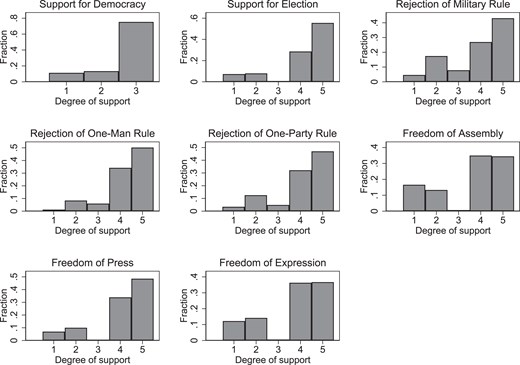
Distribution of attitude to democracy. Note: The answer options of “Don’t know” and “Refused to answer” are coded as missing values. The answers are coded, so that they take a higher value for the respondents who support democracy more strongly.
Identification strategy
Estimation model
This study uses the unexpected event during survey design by exploiting the quasi-experimental situation where the coup coincided with the Afrobarometer survey (Muñoz et al., 2020). The basic idea behind this design is that respondents interviewed just before and after the coup should have similar characteristics, except for the fact that the latter group was exposed to information about the coup.
While this strategy is frequently used in the social sciences, there is no consensus on the bandwidth of the control and treatment periods, given the trade-off between sample size and the internal validity of estimates. On the one hand, if it is too wide, the respondent characteristics may not be balanced. On the other hand, a narrower bandwidth requires a larger sample size per interview day and assumes that citizens learn of a coup and react to it immediately. Therefore, it leads to an underestimation of the impact if respondents' attitudes change slowly.
In this study, while the survey started on December 9th (i.e., 14 days before the coup) and ended on the 31st (9 days after), we set the bandwidth to be 9 days before and after the coup in the main specification. The sample prior to this period consists largely of respondents from Liberia, raising concerns about sample selection bias. We show in “Results” that the respondent characteristics are balanced and that the main results are robust to changes in the bandwidth (i.e., 6 days and 3 days).
Using the restricted sample, we estimate the following weighted least squared model, where the observations are weighted by the sampling weight:
where denotes the democratic attitude of respondent i, interviewed on day t in region j. takes unity for the respondent interviewed after the coup, and zero otherwise. includes gender, age, educational attainment (primary, secondary, and post-secondary education), religion, employment with cash income, the ownership of radio and TV, past voting behavior, attendance to a demonstration or protest, an indicator of the same language as Guineans, an indicator for living in an urban area, and indicators for living in a PSU with electricity, piped water, and military presence. Finally, denotes the regional fixed effects. Mali has 9 regions and Liberia has 15 regions. These fixed effects enable us to compare the democratic attitude between those interviewed just before and after the coup in the same region.
Threats to identification
Our identification strategy relies on two underlying assumptions (Muñoz et al., 2020): excludability and ignorability. Excludability assumes that the timing of interviews should affect democratic attitude only through exposure to the news of the coup. This assumption can be violated if the timing of the coup was endogenous to respondents. However, this concern is unlikely to be serious for two reasons. First, the priority for CNDD to determine the timing of the coup is the probability of success. Therefore, CNDD does not have a strong incentive to consider the political and economic conditions in Mali and Liberia, given that there was little political pressure from these countries to affect the probability of success. Second, the coup occurred immediately after the death of the former President, Lansana Conté. Even if people were aware that he would pass away shortly and this would trigger political instability in Guinea, it is impossible to predict the date of death exactly.
Other potential threats to excludability may exist, such as collateral events, simultaneous events, and unrelated time trends. First, collateral events are responses that incidentally occur after the event of interest. Such events make it difficult to distinguish the impact of the event of interest on outcomes from the impact of other events. We discuss that this issue is not severe in Online Appendix B1. Second, simultaneous events are those that occur at the same time but are unrelated to the event of interest. To our knowledge, no notable events occurred on December 23, 2008, in these or the surrounding countries. Although Christmas can be a simultaneous event for Christians, we address this concern in Online Appendix B1. Third, the problem of unrelated time trends occurs when the outcome changes with some trend over continuous time. We rule out this possibility in “Main Results”.
Ignorability assumes that respondents' potential outcomes are independent of the interview timing—meaning that whether a respondent was interviewed before or after the coup was effectively random. It can be violated if the respondents are non-randomly selected or the response rate is low. Another potential cause of violation is the possibility that the respondent characteristics change following the coup. For example, the response rate of those interested in politics may increase after the coup, if they consider that the survey is an opportunity to express their political opinion. However, these issues are unlikely to be severe because, as discussed in the data section, the respondents were selected randomly, and the response rate was remarkably high in both countries. We also provide evidence that the proportion of missing values of the democratic attitudes is uncorrelated with the treatment in Online Appendix B2.
Furthermore, we conduct the balance test in Table 2. Although many empirical studies in the social sciences either test the equality of means for each covariate across treatment status (pairwise t-tests) or test the joint orthogonality of covariates by regressing the treatment indicator on the covariates (omnibus F-tests). However, these approaches are prone to over-rejecting the null (Kerwin et al., 2024). Therefore, following Kerwin et al. (2024), we adjust the p-value of the omnibus F-test by using the randomization inference p-value. The table shows that the covariates are balanced.
Balance tests.
| (1) | (2) | (3) | |
|---|---|---|---|
| Male | −0.006 | −0.006 | −0.041† |
| (0.012) | (0.014) | (0.021) | |
| Age | −0.000 | −0.000 | 0.001 |
| (0.001) | (0.001) | (0.001) | |
| Job with cash income | −0.013 | −0.010 | −0.038 |
| (0.027) | (0.032) | (0.033) | |
| Primary education completed | −0.060* | −0.048† | −0.052 |
| (0.025) | (0.029) | (0.043) | |
| Secondary education completed | −0.077* | −0.058 | −0.039 |
| (0.031) | (0.037) | (0.055) | |
| Post-secondary education completed | −0.062 | −0.050 | −0.005 |
| (0.040) | (0.050) | (0.076) | |
| Christian | −0.080 | −0.064 | 0.063 |
| (0.065) | (0.075) | (0.084) | |
| TV/radio ownership | 0.035 | 0.025 | 0.035 |
| (0.023) | (0.027) | (0.038) | |
| Voted in the last election | −0.016 | −0.018 | 0.034 |
| (0.023) | (0.028) | (0.037) | |
| Attended a demonstration or | 0.023 | 0.007 | 0.057 |
| protest march during the past year | (0.029) | (0.034) | (0.051) |
| Same language as Guinea | 0.106† | 0.116 | −0.042 |
| (0.059) | (0.074) | (0.080) | |
| PSU: Urban | −0.002 | −0.054 | −0.103 |
| (0.066) | (0.078) | (0.165) | |
| PSU: Electricity grid | 0.105 | 0.245* | 0.228 |
| (0.102) | (0.114) | (0.221) | |
| PSU: Piped water | 0.087 | 0.051 | 0.118 |
| (0.063) | (0.083) | (0.149) | |
| PSU: Soldiers or army vehicles | 0.191 | 0.157 | 0.142 |
| (0.122) | (0.127) | (0.254) | |
| Regional FE | Yes | Yes | Yes |
| Bandwidth | ±9 days | ±6 days | ±3 days |
| Observations | 1,810 | 1,360 | 675 |
| R-squared | 0.370 | 0.353 | 0.347 |
| F | 2.22 | 2.14 | 2.20 |
| Randomization inference p-value | 0.142 | 0.168 | 0.384 |
| [0.113–0.176] | [0.136–0.204] | [0.341–0.428] |
Note. The OLS coefficients are reported. The dependent variable is the binary indicator of interview after the coup. The sample is adjusted by the sampling weight. Standard errors clustered at the level of interview date and region are in parentheses. The F-tests of joint orthogonality are performed. The randomization inference p-values (500 random permutations) are reported, and their 95% confidence intervals are in brackets. PSU stands for primary sampling unit. †p < .10, *p < .05, **p < .01, ***p < .001.
Results
Main results
We first examine the impact on the standardized composite index of democratic attitudes. Table 3 shows the estimation result of Equation (1). Column (1) controls only for regional fixed effects, while the other columns include respondent and PSU characteristics. Column (2) demonstrates that those exposed to information about the coup are 0.259 standard deviation (SD) more likely to support democracy, suggesting significant spillover effects of the coup on democratic attitude in neighboring countries. The result remains robust to changes in the bandwidth of sample restriction (Columns (3) and (4)). Column (5) restricts the sample to regions surveyed both before and after the coup, allowing us to exploit within-region variation in exposure to information about the coup. The results align with our benchmark results. The full estimation results of Column (2) are reported in Table A5. Online Appendix B2 and Table A6 present the results of robustness tests, such as the additional controls, the impact on religiosity and missing values, and estimation by the entropy balancing method (Hainmueller, 2012).
The impact of the coup on democratic attitudes.
| (1) | (2) | (3) | (4) | (5) | |
|---|---|---|---|---|---|
| Interviewed after the Coup | 0.241** | 0.259** | 0.225** | 0.202* | 0.266** |
| (0.057) | (0.061) | (0.077) | (0.077) | (0.061) | |
| Regional FE | Yes | Yes | Yes | Yes | Yes |
| Controls | No | Yes | Yes | Yes | Yes |
| Bandwidth | ±9 days | ±9 days | ±6 days | ±3 days | ±9 days |
| Observations | 1,810 | 1,810 | 1,360 | 675 | 1,457 |
| R-squared | 0.035 | 0.081 | 0.090 | 0.131 | 0.085 |
Note. The OLS coefficients are reported. The dependent variable is the composite index of democratic attitudes. The sample is adjusted by the sampling weight. Standard errors clustered at the level of interview date and region are in parentheses. Column (5) uses the respondents from the regions surveyed both before and after the coup. †p < .10, *p < .05, **p < .01. ***p < .001.
Figure 2 examines changes in treatment effects over time by regressing the democratic attitudes on binary indicators for the interview date (3-day spans), instead of using an indicator for interviews conducted after the coup. Figure A1 illustrates the number of respondents per day, suggesting approximately 300 observations in each span. The reference group consists of those interviewed one to 3 days before the coup (i.e., December 20th, 21st, and 22nd). The coefficients are close to zero and statistically insignificant before the coup, supporting the validity of our identification strategy. Democratic attitudes increase immediately after the coup by 0.198 SD, and one week later, the impact of exposure rises to 0.355 SD. The results do not change with the inclusion of respondents interviewed before December 14 to the sample (Figure A2).
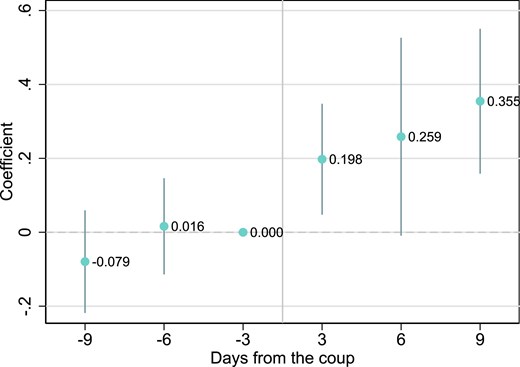
Change in the treatment effects over time. Note: OLS estimates of lags and leads and the corresponding 95% confidence intervals are reported. The reference point is 1–3 days before the coup. The model includes the same controls as Table A5. The sample is adjusted by the sampling weight. N = 1,810. Standard errors are clustered at the level of interview date and region.
Heterogeneity
Figure 3 estimates Equation (1) with different subsamples to examine the heterogeneous impact across different areas and respondent characteristics. First, we explore heterogeneity across countries, as they differ in socioeconomic and ethno-linguistic characteristics. Second, since multiple languages are spoken in these three countries, we split the sample by whether the respondent's primary language is commonly used in Guinea. Those who speak the same language as Guineans may perceive them as in-group members and feel sympathy toward them. Third, we test heterogeneity across TV and radio ownership. Fourth, those who trust AU and ECOWAS may be more likely to take their condemnatory statements seriously. We therefore split the sample into those who perceive these regional organizations as “very helpful” and those who do not. Fifth, respondents residing near Guinea may be more affected by Guinean economic instability and respond more sensitively to the information. Sixth, since coups deprive citizens of the opportunity to vote, the impact may be greater among those who participated in the previous election. Finally, heterogeneity by basic respondent characteristics, such as gender, educational attainment, and religion, is tested. Since we examine the impacts for 19 subsamples, we conduct the multiple hypotheses testing of Anderson (2008).
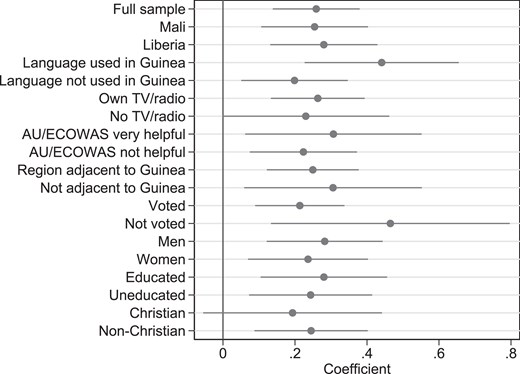
Heterogeneous impact. Note: The specifications of Column (2) of Table 3 are estimated. OLS coefficients and the corresponding 95% confidence intervals are reported. The sample is adjusted by the sampling weight. Standard errors are clustered at the level of interview date and region.
Figure 3 demonstrates that the impacts remain robust. Our conceptual framework suggests the possibility of heterogeneity across the factors, such as individuals' access to mass media and political participation. However, the point estimates are positive and statistically significant regardless of sample restrictions. The results are also comparable across basic respondent characteristics, such as sex, educational attainment, and religion, as Anderson's (2008) q-value is 0.019 for the Christian sample (not reported in the figure). These patterns suggest that reinforcing democratic attitudes is a common response across types of citizens and areas, and therefore, it is not driven by a particular sample. These results are important for assessing the external validity of our findings.
However, the figure also demonstrates that the point estimate is larger for those who speak a language used in Guinea than for those who speak the other languages. This is intriguing because those who use the same language are expected to feel sympathy for Guinean citizens, given the in-group bias. We also find a large coefficient among those who did not vote in the previous election. However, we should be cautious in interpreting the results, as the sample size is small (Table 1) and the results are not precise.
Finally, although the magnitude of the average impact is comparable across TV/radio ownership in Figure 3, it is plausible that those who own TV or radio respond more quickly following the coup than those who do not. Therefore, we estimate the specification in Figure 2 for those with and without ownership. Figure 4 demonstrates the pattern consistent with our expectation. The owners significantly change their attitudes within 3 days after the coup, while the others react more than a week later.
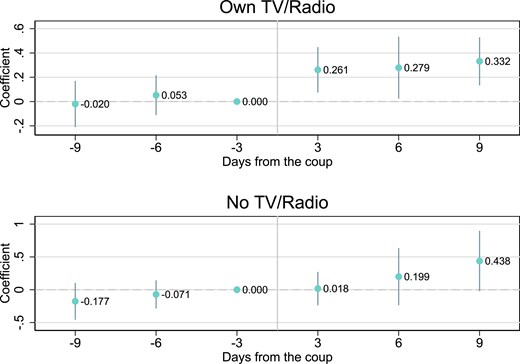
Heterogeneity by the ownership of TV and radio. Note: OLS coefficients and the corresponding 95% confidence intervals are reported. The sample is adjusted by the sampling weight. Standard errors are clustered at the level of interview date and region.
Mechanisms
Our conceptual framework suggests that the positive impact on general attitudes toward democracy occurs when citizens reaffirm their commitment to democracy or when they perceive the coup as a tool of political liberalization (i.e., a democratic coup). The latter predicts citizens' support for a coup in their own country and raises the risk of coup contagion, even though the impact on overall democratic attitude is positive. Therefore, we identify these mechanisms by examining the impact on each measure of democratic attitudes.
Figure 5 summarizes the coefficients of the interview after the coup, estimated by the specification of Column (2) of Table 3. The composite index result is reproduced at the bottom of the figure for reference. The figure demonstrates that citizens exposed to information about the coup are more likely to support democracy and elections and reject authoritarian regimes, such as military rule, one-man rule, and one-party rule. This suggests that citizens consider the coup as a cause of political instability, rather than an opportunity of liberalization. The impacts on attitudes toward freedom are positive but not robust, presumably because citizens do not directly relate the coup to a violation of freedoms. The full estimation results are reported in Table A5. It shows that the results do not change qualitatively after adjusting the p-values of all coefficients using Anderson's (2008) q-values. TV/radio ownership is positively correlated throughout, but it is statistically significant only in Column (1). This does not contradict Figures 3 and 4, as those figures show differences in democratic attitudes by ownership only among post-coup respondents.
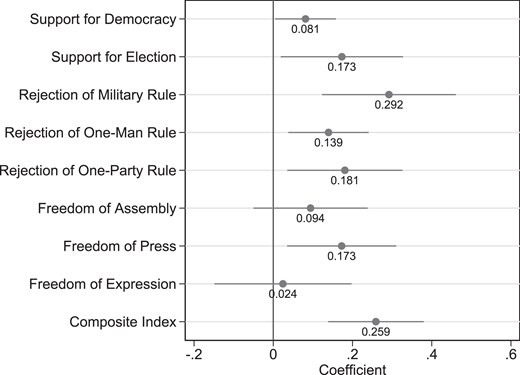
Underlying mechanisms. Note: The OLS coefficients of the interview after the coup and the corresponding 95% confidence intervals are reported. The specifications of Column (2) of Table 3 are estimated. The sample is adjusted by the sampling weight. N = 1,810. Standard errors are clustered at the level of interview date and region.
These findings raise another relevant question: the mechanisms underlying increased support for elections and democracy and the rejection of authoritarian regimes. We, therefore, discuss the validity of potential mechanisms. First, citizens' social learning about the poor performance of the military regime in Guinea may lead them to support democracy and elections and to reject a military regime. However, this channel is not plausible because the exacerbation of political instability in the post-coup regime occurred in 2009, after the period covered by our analysis. The second explanation is media bias in Liberian and Malian mass media. However, this is also unlikely because the coup was reported in a neutral manner “Domestic and international reactions to the coup”.
Third, despite exposure to neutral media reports, citizens may respond more strongly to condemnatory statements than to those by Dadis Camara, particularly if they have high level of institutional trust in political leaders and regional organizations. We test this conjecture by exploiting heterogeneity by perceptions of the AU and ECOWAS in Figure 3. This channel predicts a larger attitudinal impact among individuals who trust the AU and ECOWAS. By contrast, if attitudinal changes are driven by objective information about the coup rather than by condemnatory statements, the effect sizes should be comparable across groups. Figure 3 shows that differences in effect size are marginal. Therefore, the role of institutional trust appears to be limited. Notably, although the presidents of Mali and Liberia also condemned the coup, we do not use their perception in the heterogeneity analysis. This is because the perception about the president's performance can be affected by the occurrence of the Guinean coup, leading to the bad-control problem. For robustness, we also split the sample into those who positively evaluate the performance of AU, ECOWAS, and the president and those who do not. The results do not change qualitatively (Columns (1) and (2) of Table A7).
Fourth, those who are concerned about a deterioration in their future economic conditions due to political instability in Guinea may also support democracy and reject the coup, even without social learning or belief updating. However, this is unlikely to explain our results, given the comparable effect sizes across geographical proximity to Guinea (Figure 3). To further test the validity of this channel, we estimate the impact of exposure on respondents' expectations about the future economic situation of their country and household. Columns (3) and (4) of Table A7 demonstrate that they do not change after exposure, contradicting this explanation.
Overall, these results do not lend strong support for the channels through social learning about the poor performance of the post-coup Guinean regime, media bias, institutional trust, or concern about the economic instability. This suggests that attitudinal changes may be driven by exposure to objective information about the coup. This is plausible because citizens in West Africa have experienced many coups and are aware that coup plotters are likely to become the next dictator, even if they initially behave democratically.
Discussion
The relationship between democratic attitudes and coup contagion
Although the previous section demonstrates that media reports of the coup reinforce citizens' democratic support, two further conditions must be met to actually reduce the coup contagion, as discussed in “Conceptual framework”. First, the attitudinal impact on democratic support persists. Second, the militaries in Mali and Liberia recognize the change in citizens' democratic attitudes. In this section, we discuss the validity of these conditions.
Regarding the first condition, Figure 2 demonstrates that the attitudinal impact rises over time from 0.198 SD during the first 3 days to 0.355 SD after a week. The impact may increase further after the period covered by our analysis, due to the delay in attitudinal reactions among those without TV/radio (Figure 4). Furthermore, given the possibility of the attitudinal change driven by social learning, individuals' democratic support is unlikely to decline unless they are exposed to an event that raises the perceived value of military rule. This is unlikely because mass media in these countries continued to report on political instability in Guinea even after 2009, including its suspension from the AU and ECOWAS, the coup leader's breach of his pledge regarding presidential elections, protest against the military regime and their violent suppression, and the assassination attempt on the leader (Online Appendix A). Hence, if anything, citizens' support for democracy should have been further strengthened. In addition, these reports serve as reminders of ongoing political instability in Guinea. The literature suggests that repeated exposure to such reminder messages increases the issue salience and can lead to persistent attitudinal and behavioral changes, such as technology adoption, saving, and healthy behavior (Blekking et al., 2026; Calzolari & Nardotto, 2017; Karlan et al., 2016; Keoleian, et al., 2015; Larochelle et al., 2019). Finally, previous studies demonstrate that political attitudes are stable and change slowly throughout individuals' life cycles (Jennings & Niemi, 1978; Lechler & Sunde, 2019; Sears & Funk, 1999). Bratton and Mattes (2001) demonstrate that African citizens' democratic support is uncorrelated with their perceived economic/political conditions or subjective well-being. These arguments suggest that our respondents' democratic support is likely to persist. However, we should be careful about this interpretation because we cannot directly test it due to the data unavailability.
The second condition is also plausible. First, militaries have a strong incentive to monitor citizens' attitudes toward a coup and a military regime, since they influence the consequences of a coup (Grewal & Kureshi, 2019; Marinov & Goemans, 2014; Yukawa et al., 2022). Second, citizens in West African countries, including Mali and Liberia, actively participate in politics and publicly express their views. Table A2 shows that 14% of respondents in West African countries participated in a demonstration or protest within a year before the interview. It is, therefore, plausible to assume that citizens expressed their reactions to the Guinean coup as well. To provide suggestive evidence for this possibility, we estimate the impact of the Guinean coup on the frequency of discussing politics. This dependent variable is suitable for our identification strategy because it can change immediately in response to the coup, unlike participation in protests and demonstrations. Column (5) of Table A7 shows the increase in the frequency of discussing politics following the coup. In Column (6), we additionally control for the composite index of democratic attitudes. The coefficient decreases by 31% (from 0.117 to 0.081), suggesting that the observed behavioral change is mainly attributable to changes in democratic attitudes. Finally, using the pre-coup sample, we confirm that the frequency of political discussion is significantly correlated with more explicit political actions, such as demonstration/protest (rho = 0.08, p = .009) and voting (rho = 0.06, p = .037) (not reported in the table).
Contrasting reactions in Guinea and neighboring countries
It is intriguing that citizens in Guinea and in neighboring countries reacted in opposite ways. There are two potential explanations, although testing them directly is challenging due to the lack of data from Guinea. First, Guinean citizens may have been dissatisfied with their socioeconomic conditions and therefore expected the coup to promote political stability and economic development. However, this explanation is inconsistent with our findings in “Mechanisms,” which show robust effects among less-educated respondents and in Liberia, where GDP per capita is among the lowest in West Africa (Table A2).
Second, the divergence may be attributable to media capture in Guinea: a situation in which governments or other interest groups control media content. In Guinea, the coup organizer seized state radio and television and broadcast only statements by Dadis Camara, such as pledges to hold presidential elections and accusations that the previous regime was responsible for economic stagnation and political repression (Arieff & Cook, 2009). Therefore, the organizers could be framed as a revolutionary or even heroic force within Guinea. Grewal and Kureshi (2019) argue that coup leaders often promise elections to portray their actions as legitimate and supported by citizens, and Dadis Camara's initial statements are consistent with this argument. However, a notable contrast is that, despite these pledges, international responses were largely condemnatory, and citizens in neighboring countries exhibited stronger support for democracy. This suggests that public opinion in Guinea may have been shaped by biased media coverage favoring the CNDD.
Conclusion
This study investigated the impact of exposure to information about the 2008 Guinean coup on citizens' democratic attitudes in Liberia and Mali. We showed that exposure to this information reinforces citizens' support for democracy, in contrast to Guinean citizens' support for the coup. The strong effects on democratic support are attributed to the increase in support for elections and rejection of authoritarian regimes. By contrast, the attitudes toward freedoms are not affected. These results cannot be explained by learning about the poor performance of military regimes, media bias, institutional trust, or changes in citizens' expectations about future economic instability.
Two key insights emerge from our findings. First, citizens in Guinea and in neighboring countries reacted in opposite ways. Although this interpretation is necessarily speculative, the divergence is likely attributable to differences in the media environment: in Guinea, press freedom was restricted by the coup organizers (i.e., media capture), whereas media in neighboring countries reported the coup in a largely neutral manner. Second, stronger democratic support in neighboring countries may reduce incentives for coups, as coups without popular backing are costly. However, whether these attitudinal changes actually mitigate the occurrence of coups depends on assumptions such as the persistence of these changes and the extent to which they are observable to the military. Although these assumptions are plausible, we cannot directly test their implications for coup contagion due to data limitations. Further research is needed to address these gaps.
Despite these limitations, the following policy implication can be derived. The concept of coup contagion is widely recognized among political leaders. Consequently, governments often implement coup-proofing strategies following a coup in a neighboring country, such as monitoring potential coup plotters (Miller et al., 2018; Pilster & Böhmelt, 2012). In addition to these strategies, this study suggests the role of swift and stringent international responses to coups in reducing the risk of contagion. Such responses are reported in the mass media and can lead citizens to express stronger support for democracy. This, in turn, reduces incentives to organize coups, particularly when potential coup leaders are aware of pressure from donor countries against coups and military governments lacking popular support.
Acknowledgments
The authors would like to express gratitude to Ayako Kondo, Masaaki Higashijima, Yasuyuki Sawada, Hitoshi Shigeoka, Yoshito Takasaki, Ryuichi Tanaka, and Shigeki Uno for their valuable comments. Special thanks are due to the seminar participants at the Japanese Economics Association. The usual disclaimer applies.
Author contributions
Yu Osaki: Conceptualization, Methodology, Formal analysis, Data curation, Visualization, Writing. Masahiro Shoji: Conceptualization, Validation, Funding acquisition, Investigation, Supervision, Writing. The authors contributed equally to this study.
Funding
This study was financially supported by the Japan Society for the Promotion of Science (20K01689; PI: Masahiro Shoji).
Data availability
The dataset, codebook, and do-files for the empirical analysis in this article, along with the Online Appendix, are available at https://www.prio.org/journals/jpr/replicationdata. All analyses were conducted using Stata 17.
References
Biographical statements
Yu Osaki. MA in Economics (The University of Tokyo, 2024); Consultant, Policy Research & Consulting Division, Mitsubishi UFJ Research and Consulting Co., Ltd (2024-); research interests: policy evaluation, public opinion, conflict, development, and disaster.
Masahiro Shoji. PhD in Economics (The University of Tokyo, 2009); Professor of Institute of Social Science, The University of Tokyo (2021-); research interests: development economics.
Author notes
Conflicts of interest: None declared.


