


Abstract
In 2014, nintedanib and pirfenidone became the first approved therapies to slow IPF progression. In 2019, nintedanib was approved for PF-ILD. While several real-world studies on antifibrotic (AF) use in IPF show low uptake, limited research examines AF use and IPF/PF-ILD diagnosis by care setting. We compared Academic (AC) vs Non-Academic (NonAC) centers, evaluating diagnoses, AF uptake, and treatment predictors.
Using the TriNetX U.S. Network, we created retrospective cohorts. From 40,505,857 patients across 71 HCOs, we identified adults with IPF (J84.112; 2010-2024; n = 59,890: AC 42,536, NonAC 16,470, unclassified 884) and PF-ILD (J84.170; 2018-2024; n = 2,358: AC 1,716, NonAC 216, unclassified 426). We compared AC vs NonAC incidence, prevalence, and AF uptake overall and in post-trial windows (INPULSIS/ASCEND 2014-2017; INBUILD 2019-2022). Trends were modeled with linear regression (SPSS). Proportions were compared with z tests, means with t tests, and demographics with propensity-matched logistic and Cox models.
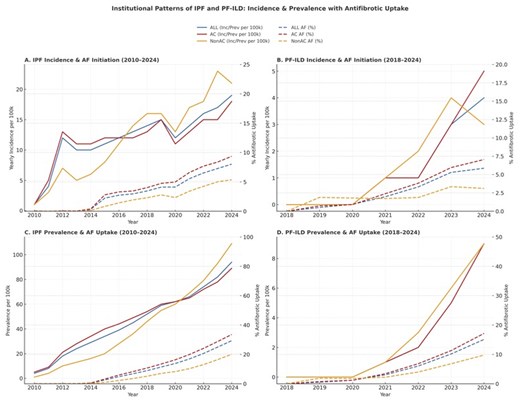
In IPF, NonAC diagnosis rates started lower but finished higher, increasing faster than ACs (2024 prevalence 109 vs 89/100k; β_prevalence 2010-2024 +7.43 vs + 5.50/100k/y; β_incidence +1.45 vs + 0.73/100k/y; all p<.001). AF use was higher and rose faster at ACs (2024 prevalence 33.5% vs 20.1%, z = 9.66, p<.001; incidence 9.3% vs 5.4%, z = 9.15, p<.001; β_prevalence +2.42 vs + 1.37 pp/y; β_incidence +0.71 vs + 0.41 pp/y; all p<.001). Post-INPULSIS/ASCEND, uptake accelerated more at ACs (β_incidence +0.97 vs + 0.60 pp/y, p=.020; β_prevalence +2.61 vs + 1.16 pp/y, p<.001). Odds ratio for AF at AC vs NonAC was 1.708 (1.594-1.83).
In PF-ILD, prevalence was similar in 2024 (9.0/100k; z = 0, p = 1.0). AF uptake was higher and faster at ACs (2024 prevalence 17.1% vs 9.8%, z = 3.59, p<.001; β_prevalence +2.79 vs + 1.48 pp/y, p=.027; incidence 7.1% vs 3.1%, z = 2.99, p=.003; β_incidence +1.23 vs + 0.44 pp/y, p<.001). Post-INBUILD, uptake accelerated more at ACs (β_incidence +2.56 vs + 1.47 pp/y, p=.008). Odds ratio for AF treatment at AC vs NonAC was 1.319 (0.634-2.745).
In IPF, AF uptake was more likely in male, White, BMI>18.5 (OR 1.49 [1.42-1.56]; 1.60 [1.43-1.79]; 1.78 [1.40-2.27]). Demographic differences did not reach significance in PF-ILD.
Overall AF treatment rates for IPF and PF-ILD remain low. Post-trial, AF use was higher at ACs, reflecting faster adoption of guidelines. In IPF, treatment disparities favored White, male, and BMI>18.5 patients; none were seen in PF-ILD. Persistent gaps highlight the need for interventions ensuring equitable, guideline-driven ILD care. As new antifibrotics emerge, proactive strategies are essential to close diagnostic and treatment disparities across settings.
This abstract is funded by: None


