


Abstract
The ICD-10 code J84.170 was introduced to identify patients with progressive fibrosing interstitial lung disease (PF-ILD), but real-world prevalence remains uncertain due to diagnostic complexity. To better characterize under-diagnosis, we sought to: (1) estimate uncoded patients by comparing coded cases to three proxy-derived cohorts (sensitive, specific, strict), (2) assess miscoding, (3) compare antifibrotic (AF) use, (4) evaluate demographics, and (5) examine ILD subtype distribution.
We used the TriNetX U.S. network (2021-2024) to identify adults with coded PF-ILD (J84.170) and three proxy cohorts derived from ILD diagnoses and published progression criteria (repeat CT, PFTs, etc.). We calculated prevalence, demographics, AF uptake, and cohort overlap. Proxy algorithms were assessed using sensitivity, specificity, Youden’s J, κ, and PABAK. Group comparisons used Pearson’s χ² or Welch’s t-test in SPSS, and TriNetX was used for ORs and HRs.
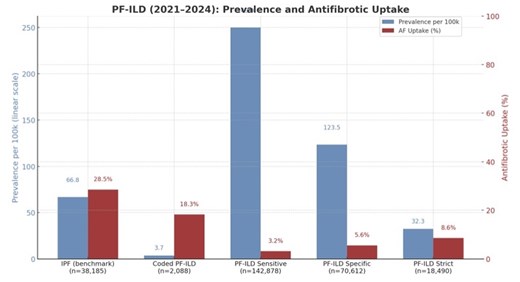
Among 57,193,009 adults, coded PF-ILD prevalence was 3.7/100k (n = 2,088) compared with 249.9, 123.5, and 32.3/100k for sensitive (n = 142,878), specific (n = 70,612), and strict (n = 18,490) proxies. Only 1.4-10.0% of proxy patients carried J84.170. AF uptake was 18.3% in coded cases vs 3.2-8.6% in proxies (OR range 1.56 [95% CI 1.11-2.19] to 6.80 [95% CI 3.91-11.91]). Overlap was limited: 48.4% of coded patients met sensitive proxy criteria (κ 0.01, PABAK 0.26, J 0.13), 41.8% specific (κ 0.02, PABAK 0.63, J 0.24), and 17.8% strict (κ 0.04, PABAK 0.90, J 0.16). Many coded cases did not fulfill proxy progression definitions, suggesting miscoding.
Compared to IPF, coded patients had more respiratory failure (HR 1.789; 95% CI: 1.538-2.151) and deaths (HR 1.908; 95% CI: 1.515-2.410) suggesting late diagnosis, and lower AF use (OR 0.507; 95% CI: 0.382-0.672). Demographics were similar between coded and sensitive groups (age 66.4 ± 15.0 vs 66.6 ± 14.3 years; male 40.7% vs 40.8%; White 66.9% vs 66.0%; Black 15.9% vs 14.5%; all nonsignificant). The strict proxy differed only in age (67.6 ± 14.2 vs 66.4 ± 15.0, p = 0.047). Subtype prevalence was also similar: unclassifiable (71.2% vs 73.5%), CTD-ILD (10.6% vs 8.4%), RA-ILD (9.7% vs 4.5%), HP (4.2% vs 2.2%), sarcoidosis (2.7% vs 3.7%), and others each 1-5%.
ICD-10 coding for PF-ILD identifies a small, sicker subset of patients while missing many who meet proxy progression criteria. AF use is concentrated among coded patients, leaving large uncoded populations potentially untreated. Despite low raw concordance, proxy algorithm validity metrics support their use as EHR screening tools. Overall, undercoding and miscoding hinder accurate prevalence estimates and equitable treatment.
This abstract is funded by: N/A


